


Supportive work environment in education: concept and dimensions
The construct of SWE emerged from organizational psychology in the early 20th century, with its significance gaining recognition as industrialization advanced. During this period, scholars increasingly noted that the work setting exerts a profound influence on employees’ physical and mental well-being, as well as their work efficiency (Zhong and House, 2012). This understanding was further solidified by the Hawthorne studies (Hassard, 2012), which highlighted the pivotal role of the work environment in shaping employees’ behaviors and attitudes. Conceptually, SWE refers to a collection of organizational cultures and management practices designed to foster a positive, healthy, and safe working environment, ultimately promoting employees’ well-being and productivity (Ángeles López-Cabarcos et al., 2022). Among early conceptualizations, Broad and Newstrom (1992) identified four core components of SWE: perceived organizational support, perceived climate, supervisory relationship, and peer group interaction, each capturing distinct aspects of how support operates within organizational structures.
The introduction of SWE into educational contexts holds significant importance, as it directly enriches teachers’ professional experiences, fosters their growth, and elevates overall educational quality (Wu and Zeng, 2024). However, the academic community remains divided regarding both the terminology used to describe this construct and its constituent components. In terms of terminology, some scholars adopt labels rooted in organizational psychology, such as “SWE” (Zeng et al., 2024), while others use terms like “school climate” (Ryberg et al., 2020) or “working conditions” (Toropova et al., 2021). We opted for “SWE” because “school climate” typically encompasses perceptions from both teachers and students, diluting focus on the workplace experience specific to educators, and “working conditions” fails to emphasize the positive, supportive attributes central to our inquiry.
Regarding the components of SWE, scholarly perspectives vary widely. Zeng et al. (2024) strictly adhere to the four-dimensional framework proposed by Broad and Newstrom (1992), while Masoom (2021) categorizes it to three components: organizational encouragement, supervisory encouragement, and workgroup support. Toropova et al. (2021) expand the construct further, identifying five distinct aspects: student discipline, leadership support, school resources, teacher cooperation, and teacher workload. From another angle, Yada and Savolainen (2023) measure SWE across five dimensions: affiliation, innovation, participatory decision-making, resource adequacy, and student support. Given our goal of developing a streamlined SWE scale with fewer factors and items, Masoom’s (2021) three-dimensional model was selected for its balance of comprehensiveness and conciseness, making it the most suitable foundation for our study.
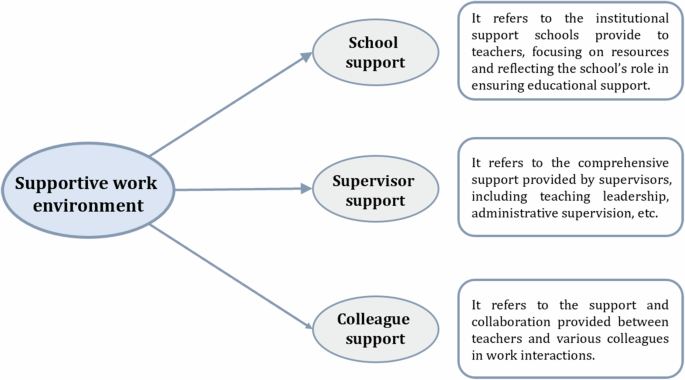
To make this framework more applicable to school contexts—where organizational psychology terms, often derived from corporate settings, may not fully capture the unique dynamics of educational environments—we adjusted the dimension labels while maintaining the essence of Masoom’s (2021) model (see Fig. 1). Specifically, “organizational encouragement” was redefined as “school support” to better reflect the educational setting, aligning with terms like “school resources” (Toropova et al., 2021) and “resource adequacy” (Yada and Savolainen, 2023), which emphasize institutional support in schools. “Supervisory encouragement” was renamed “supervisor support” to broaden its scope, acknowledging that school supervisors (e.g., principals, department heads) play roles beyond mere “encouragement”, including instructional leadership, administrative oversight, and fostering professional growth (Harris and Jones, 2023). Lastly, “workgroup support” was changed to “colleague support” to clarify that it encompasses both teaching and non-teaching staff (e.g., administrative personnel) who collaborate with teachers in their daily activities, reflecting the inclusive nature of the “workgroup” concept in Masoom’s (2021) model and echoing Toropova et al.’s (2021) emphasis on “teacher cooperation” as a key aspect of SWE in schools.


Three core components of SWE.
Benefits of supportive work environment to L2 teachers
Previous research in general education has extensively documented the benefits of SWE for teachers, including enhanced job satisfaction (Toropova et al., 2021), increased self-efficacy (Jang et al., 2023), improved well-being (Dreer, 2024), higher retention rates (Li and Yao, 2022), and ultimately, better academic outcomes for students (Wartenberg et al., 2023). Studies specifically focusing on L2 teachers have emerged more recently (Zeng et al., 2024), driven by the growing influence of PP in L2 research (Wang et al., 2021). Traditionally, L2 research emphasized the inhibitory effects of negative factors (e.g., negative emotions) on students’ language learning (Zhao and Danping, 2024), but MacIntyre and Mercer (2014) highlighted that L2 learning requires sustained effort, motivation, resilience, and external support—concepts aligned with PP’s focus on positive emotions, characteristics, and institutions. As PP further integrates into L2 research, attention to L2 teachers has grown, with researchers emphasizing that SWE directly impacts their capacity for continuous learning and adaptation to evolving L2 teaching methodologies (Greenier et al., 2023; Ma and Wang, 2024; Wu and Zeng, 2024). Specifically, SWE provides necessary resources for professional development and facilitates cultural exchange through shared diverse perspectives, thereby strengthening teachers’ instructional readiness.
This instructional readiness is particularly vital for cultivating creativity, as L2 classrooms uniquely foster student creativity by exposing learners to diverse cultural perspectives, sparking curiosity, imagination, and openness—key components of creativity (Wu and Zeng, 2025). Given teachers’ centrality in this process, their mental health, especially emotional experiences, critically affects their creativity cultivation capacity (Su et al., 2024). Research confirms SWE significantly shapes these emotions: Adequate SWE fosters positive emotions like enthusiasm (Greenier et al., 2023), hope, and pride (Wu and Zeng, 2024), enhancing L2 teachers’ ability to cultivate students’ creativity. Conversely, insufficient SWE triggers negative emotions such as anxiety and anger, hindering these outcomes. Wu and Zeng (2024) explain this SWE-emotion link using Pekrun and Perry’s (2014) Control-Value Theory (CVT), which posits emotions stem from appraisals of control over and the subjective value of meaningful tasks. While control-value appraisals are central, CVT recognizes distal antecedents like environmental antecedents like SWE, which influence emotions through these appraisals. However, treating SWE as a single construct by Wu and Zeng (2024) leaves unexplored the specific links between different SWE dimensions and various teacher emotions, limiting targeted interventions from an SWE perspective.
Limitations in measuring supportive work environment in education
Despite the vital role of the SWE in promoting positive teacher outcomes, assessing this construct remains challenging. The existing literature identifies two primary methods for evaluating SWE. The first involves aggregating items from various studies to define its components. For instance, Zeng et al. (2024) drew from Tripathi and Kalia (2022) to cover areas like perceived organizational support, perceived climate, etc. Similarly, Wu and Zeng (2024) integrated these elements to assess SWE. However, this approach raises psychometric concerns: Zeng et al. (2024) did not provide model fit statistics for their aggregated scale, while Wu and Zeng (2024) presented only overall model fit indices, lacking essential details such as subscale reliability and evidence of convergent and discriminant validity. The absence of these validation steps reduces the scale’s effectiveness in capturing the specific nuances of SWE, potentially distorting its relationship with teacher outcomes.
The second method relies on the School-Level Environment Questionnaire (SLEQ) (Burden and Fraser, 1994) and its revised versions (Dang et al., 2024; Johnson et al., 2007). However, the psychometric suitability of both the original and modified versions of SLEQ has been questioned. While the original SLEQ, consisting of 56 items across eight factors, has been widely used, its developers did not conduct psychometric testing such as exploratory factor analysis (EFA) and confirmatory factor analysis (CFA) (Burden and Fraser, 1994). Johnson and Stevens (2001), after analyzing a sample of U.S. elementary school teachers, removed three factors due to low item loadings. However, the psychometric properties of their revised 35-item, five-factor model remain uncertain, as the CFA model only met fit criteria after around 30 times for residual adjustments, indicating possible overfitting.
In a subsequent revision, Johnson et al. (2007) removed 14 items, resulting in a five-factor model that showed good internal consistency among U.S. elementary and secondary school teachers. However, questions remain regarding the model fit, as important fit indices, such as chi-square to degrees of freedom ratio, Tucker-Lewis Index (TLI), and Standardized Root Mean Square Residual (SRMR), were not reported; only Comparative Fit Index (CFI) and Root Mean Square Error of Approximation (RMSEA) were provided. More recently, Dang et al. (2024) revalidated the original SLEQ with high school teachers in Vietnam, adding a “principal leadership” factor (similar to “supervisor support”), suggesting that the internal structure of SLEQ may differ across cultural contexts. Their study confirmed that the revised nine-factor model demonstrated strong reliability and validity. However, this model includes 38 items, which may be too lengthy for studies focusing on multiple constructs. Overall, the evolution of SLEQ demonstrates its structural instability and cultural sensitivity, limiting its generalizability across different educational and national contexts. Moreover, none of these versions have been validated in China or among university teachers, raising doubts about the relevance of existing SLEQ versions for L2 teaching in China.
These limitations—particularly the contextual reliance of SLEQ and the lack of thorough validation for ad-hoc scales—diminish the rigor and reliability of SWE research in L2 education. Consequently, this study aims to create the Supportive Work Environment Scale (SWES) assess its psychometric properties specifically among L2 teachers (see Fig. 2). Additionally, to inform emotion-focused interventions for improving L2 teachers’ mental health, this research also explores the relationship between SWE dimensions and their emotional experiences (i.e., enjoyment, hope, anxiety, and anger). The following research questions guide this study:


Steps for the development and validation of the SWES.
RQ1: What are the psychometric properties of the SWES?
RQ2: How do specific SWE factors relate to L2 teachers’ emotional experiences?
link