


Disposable EEG Electrode Market Forecast and Outlook 2025 to 2035
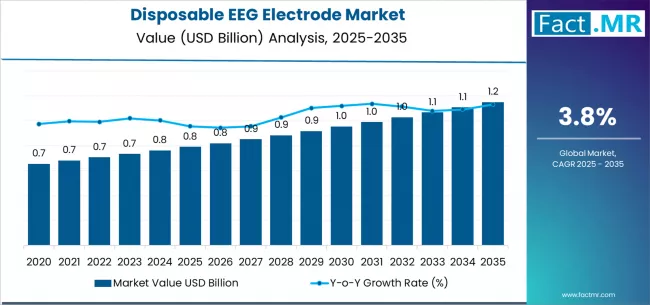
The global disposable EEG electrode market is projected to grow from USD 0.79 billion in 2025 to approximately USD 1.15 billion by 2035, registering an absolute increase of USD 0.35 billion during the forecast period. This represents overall growth of 44.6%, with the market expected to expand at a CAGR of 3.8% between 2025 and 2035. Market expansion is supported by increasing emphasis on infection control in neurological diagnostics, wider clinical adoption in hospitals and neurophysiology centers, and sustained focus on patient safety and hygiene across the global healthcare sector.
Between 2025 and 2030, the market is projected to expand from USD 0.79 billion to USD 0.95 billion, an increase of USD 0.16 billion, accounting for about 45.8% of the total forecasted growth for the decade. This phase will be defined by rising demand for single-use medical devices and broader adoption of disposable electrodes in epilepsy diagnosis, neurofeedback therapy, and sleep disorder studies.
Quick Stats for Disposable EEG Electrode Market
- Disposable EEG Electrode Market Value (2025): USD 0.79 billion
- Disposable EEG Electrode Market Forecast Value (2035): USD 1.15 billion
- Disposable EEG Electrode Market Forecast CAGR: 3.8%
- Leading Product in Disposable EEG Electrode Market: Needle Electrode (31.8%)
- Key Growth Regions in Disposable EEG Electrode Market: North America, Europe, and Asia Pacific
- Key Players in Disposable EEG Electrode Market: Medtronic plc, Ambu A/S, CONMED Corporation, Natus Medical Incorporated, Brain Scientific Inc., BIOPAC Systems Inc., Nihon Kohden Corporation, Rhythmlink International LLC, Cadwell Industries Inc., NeuroWave Systems Inc.

Healthcare facilities are increasingly shifting toward sterile, single-use electrodes to reduce cross-contamination risks and maintain consistent diagnostic accuracy. Expanding healthcare infrastructure in emerging markets is also facilitating higher adoption of disposable EEG systems, particularly in neurology departments seeking cost-effective infection control measures.
From 2030 to 2035, the market is forecast to grow from USD 0.95 billion to USD 1.15 billion, adding USD 0.19 billion, which represents approximately 54.2% of the total growth expected over the decade. This period will likely witness the integration of advanced technologies such as wireless EEG monitoring systems, signal-enhancing electrode materials, and application-specific designs for pediatric and critical care use.
Hospitals and specialized neurology centers are anticipated to adopt these enhanced systems to improve diagnostic precision and streamline workflow efficiency. The continued implementation of hospital-acquired infection prevention protocols will further accelerate the use of high-quality disposable electrodes offering stable signal performance and improved patient comfort.
The market’s earlier growth phase, between 2020 and 2025, was characterized by increasing awareness of infection control in clinical neurophysiology and the transition from reusable to disposable electrodes. Hospitals and diagnostic centers adopted single-use systems to align with evolving patient safety standards and minimize maintenance-related contamination risks.
Research and development efforts during this period focused on improving electrode adhesion, signal fidelity, and biocompatibility through material innovation. The use of hydrogel adhesives and flexible conductive polymers became more prevalent, improving both signal transmission and patient experience during long-duration EEG recordings.
Over the next decade, market development will continue to align with healthcare modernization trends and regulatory emphasis on hygiene compliance. The convergence of technological innovation, material advancement, and clinical protocol standardization is expected to sustain steady growth in disposable EEG electrode demand.
As hospitals and research institutions expand neurodiagnostic capacities, disposable electrode systems will remain central to maintaining safety standards and ensuring accurate, reproducible results across global neurological care applications.
Disposable EEG Electrode Market Key Takeaways
| Metric | Value |
|---|---|
| Estimated Value in (2025E) | USD 0.79 billion |
| Forecast Value in (2035F) | USD 1.15 billion |
| Forecast CAGR (2025 to 2035) | 3.8% |
Why is the Disposable EEG Electrode Market Growing?
Market expansion is being supported by the increasing demand for infection control measures and the corresponding need for high-quality disposable electrodes in neurophysiological recording applications across global healthcare and diagnostic operations. Modern healthcare providers are increasingly focused on advanced disposable electrode products that can improve signal quality, reduce cross-contamination risks, and enhance patient comfort while meeting stringent infection prevention requirements. The proven efficacy of disposable EEG electrodes in various neurological diagnostic applications makes them an essential component of comprehensive patient safety strategies and quality management programs.
The growing emphasis on healthcare-associated infection prevention and diagnostic accuracy optimization is driving demand for ultra-efficient disposable electrode formulations that meet stringent performance specifications and safety requirements for neurophysiological applications. Healthcare providers’ preference for reliable, high-performance single-use electrodes that can ensure consistent signal quality outcomes is creating opportunities for innovative electrode technologies and customized diagnostic solutions. The rising influence of infection control guidelines and patient safety protocols is also contributing to increased adoption of premium-grade disposable electrodes across different neurological applications and diagnostic systems requiring advanced recording technology.
Opportunity Pathways – Disposable EEG Electrode Market
The disposable EEG electrode market represents a specialized growth opportunity, expanding from USD 0.79 billion in 2025 to USD 1.15 billion by 2035 at a 3.8% CAGR. As healthcare providers prioritize patient safety, infection control compliance, and diagnostic performance in complex neurophysiological processes, disposable electrode systems have evolved from a conventional medical device to an essential component enabling hygiene enhancement, signal quality optimization, and multi-stage diagnostic accuracy across neurological operations and specialized clinical applications.
The convergence of healthcare expansion, increasing neurological disorder prevalence, specialized diagnostic organization growth, and safety requirements creates momentum in demand. High-performance formulations offering superior signal clarity, cost-effective electrode systems balancing performance with economics, and specialized variants for critical applications will capture market premiums, while geographic expansion into high-growth Asian healthcare markets and emerging market penetration will drive volume leadership. Healthcare emphasis on infection prevention and diagnostic reliability provides structural support.
- Pathway A – Needle Electrode Dominance: Leading with 31.8% market share, needle electrode applications drive primary demand through complex diagnostic workflows requiring comprehensive recording systems for neurophysiological monitoring. Advanced formulations enabling improved signal acquisition, reduced impedance levels, and enhanced diagnostic accuracy command premium pricing from healthcare providers requiring stringent performance specifications and safety compliance. Expected revenue pool: USD 252.0-364.6 million.
- Pathway B – Diagnostic Application Leadership: Dominating with 40.6% market share through an optimal balance of clinical utility and cost-effectiveness, diagnostic applications serve most neurological testing while meeting accuracy requirements. This application addresses both performance standards and economic considerations, making it the preferred choice for epilepsy diagnosis and neurological assessment operations seeking reliable recordings. Opportunity: USD 321.8-465.3 million.
- Pathway C – Hospital End-Use Dominance: Leading with 39.9% market share, hospital settings drive primary demand through comprehensive neurology departments requiring advanced electrode systems for inpatient monitoring. Specialized formulations supporting extended recording, patient comfort, and infection control command premium adoption from healthcare facilities requiring stringent safety specifications and clinical compliance. Expected revenue pool: USD 316.2-457.3 million.
- Pathway D – Asian Market Acceleration: India (4.5% CAGR) and China (4.3% CAGR) lead global growth through neurology infrastructure expansion, diagnostic capability development, and domestic disposable electrode demand. Strategic partnerships with local healthcare providers, infection control expertise, and supply chain localization enable the expansion of diagnostic technology in major medical hubs. Geographic expansion upside: USD 102.0-156.0 million.
- Pathway E – Advanced Materials & Adhesive Technologies: Companies investing in sophisticated electrode materials, hydrogel adhesive systems, and biocompatible conductive technologies gain competitive advantages through consistent signal performance and patient comfort reliability. Advanced capabilities enabling customized specifications and rapid application capture premium healthcare partnerships. Technology premium: USD 65.0-95.0 million.
- Pathway F – Supply Chain Optimization & Distribution Networks: Specialized distribution networks, strategic inventory management, and reliable cold chain systems create competitive differentiation in healthcare markets requiring consistent electrode availability. Companies offering guaranteed supply security, technical support, and clinical application documentation gain preferred supplier status with compliance-focused hospitals. Supply chain value: USD 48.0-72.0 million.
- Pathway G – Emerging Applications & Market Development: Beyond traditional diagnostic EEG, disposable electrodes in home monitoring, telemedicine neurology, and wearable neurodiagnostic systems represent growth opportunities. Companies developing new applications, supporting clinical research initiatives, and expanding into adjacent healthcare markets capture incremental demand while diversifying revenue streams. Emerging opportunity: USD 38.0-58.0 million.
Segmental Analysis
The market is segmented by product, application, end use, and region. By product, the market is divided into needle electrode, cup electrode, patch electrode, disk electrode, and others.
By application, the market is categorized into diagnostic, therapeutic, and research & clinical trials. By end use, the market is divided into hospitals, clinics, and others. Regionally, the market is divided into North America, Europe, Asia Pacific, Latin America, Middle East & Africa.
Why do Needle Electrodes Account for a Dominant Market Share?
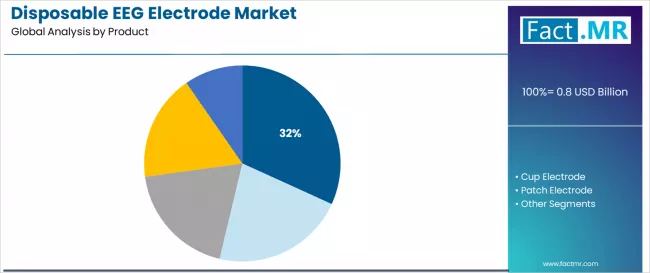
The needle electrode segment is projected to account for 31.8% of the disposable EEG electrode market in 2025, reaffirming its position as the category’s dominant product type. Healthcare providers increasingly recognize the optimal balance of signal quality and diagnostic precision offered by needle electrodes for most neurophysiological recording applications, particularly in invasive EEG monitoring and surgical neurophysiology processes. This product type addresses both performance requirements and clinical considerations while providing reliable recording systems across diverse diagnostic applications.
This product forms the foundation of most neurophysiological protocols for specialized diagnostic applications, as it represents the most clinically accepted and technically superior electrode technology for deep brain recordings in the industry. Performance control standards and extensive clinical testing continue to strengthen confidence in needle electrode formulations among neurology and neurosurgery practitioners.
With increasing recognition of the signal-quality optimization requirements in epilepsy diagnosis and intraoperative monitoring, needle electrode systems align with both clinical accuracy and patient safety goals, making them the central growth driver of comprehensive neurological diagnostic strategies.
The segment’s dominance is further reinforced by the preference for cortical needle type, which accounts for 58% of needle electrode segment value, driven by superior spatial resolution and direct cortical contact capabilities in surgical and intensive care unit monitoring applications.
By Application, How Does Diagnostic Segment Account for 40.6% Market Share?
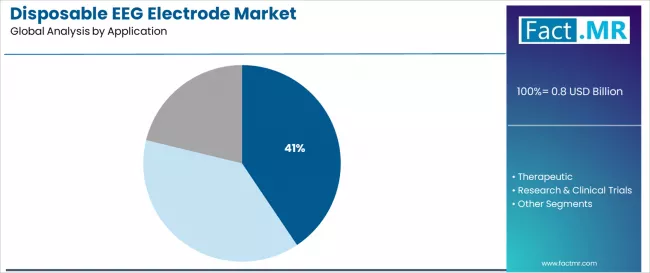
Diagnostic applications are projected to represent 40.6% of disposable EEG electrode demand in 2025, underscoring their role as the primary application segment driving market adoption and growth. Healthcare providers recognize that diagnostic requirements, including complex epilepsy evaluations, specialized seizure detection needs, and multi-channel recording systems, often require advanced disposable electrodes that standard monitoring approaches cannot adequately provide. Disposable electrodes offer enhanced infection control and signal consistency in neurological diagnostic applications.
The segment is supported by the growing nature of neurological disorder prevalence, requiring sophisticated diagnostic systems, and the increasing recognition that advanced disposable electrodes can improve diagnostic accuracy and patient safety outcomes. Neurologists are increasingly adopting evidence-based clinical guidelines that recommend specific disposable electrode specifications for optimal diagnostic outcomes.
Epilepsy and seizure diagnosis represents 49% of diagnostic application value, driven by high global prevalence and critical need for accurate ictal and interictal recording. As understanding of neurological diagnostic complexity advances and safety requirements become more stringent, disposable electrodes will continue to play a crucial role in comprehensive diagnostic strategies within the neurology market.
By End Use, What Makes Hospitals Segment Account for 39.9% Market Share?
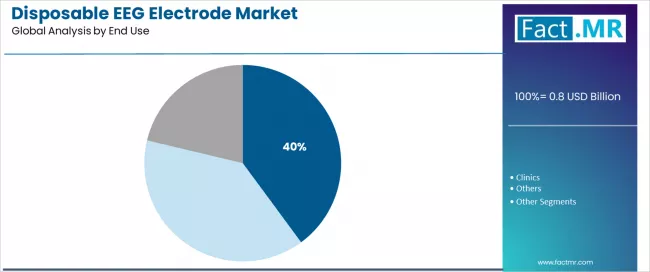
Hospitals are projected to represent 39.9% of disposable EEG electrode demand in 2025, underscoring their role as the leading end-use segment driving market adoption and growth. Healthcare facilities recognize that hospital-based neurological requirements, including complex inpatient monitoring, specialized neurology ward needs, and multi-day recording systems, often require advanced disposable electrodes that outpatient settings cannot comprehensively provide. Disposable electrodes offer enhanced infection prevention and workflow efficiency in hospital neurophysiology applications.
The segment is supported by the expanding nature of hospital neurological admissions, requiring sophisticated monitoring infrastructure, and the increasing recognition that advanced disposable electrodes can improve patient safety and reduce healthcare-associated infection rates. Hospital administrators are increasingly adopting evidence-based infection control policies that mandate specific disposable electrode usage for optimal patient outcomes.
Neurology wards represent 64% of hospital segment value, driven by concentrated neurological patient populations and intensive monitoring protocols requiring frequent electrode changes. As understanding of hospital infection control advances and regulatory requirements become more stringent, disposable electrodes will continue to play a crucial role in comprehensive patient safety strategies within the inpatient healthcare market.
What are the Drivers, Restraints, and Key Trends of the Disposable EEG Electrode Market?
The disposable EEG electrode market is advancing steadily due to increasing recognition of infection prevention importance and growing demand for high-quality single-use electrodes across the healthcare and neurological diagnostics sectors.
The market faces challenges, including higher per-unit costs compared to reusable alternatives, potential for adhesive-related skin irritation during extended monitoring, and concerns about environmental sustainability for medical waste management. Innovation in electrode materials and biodegradable adhesive technologies continues to influence product development and market expansion patterns.
Expansion of Neurology Infrastructure and Disposable Electrode Technologies
The growing adoption of specialized neurology departments is enabling the development of more sophisticated disposable electrode designs and signal quality control systems that can meet stringent diagnostic requirements.
Specialized healthcare facilities offer comprehensive electrode solutions, including advanced conductive materials and adhesive systems that are particularly important for achieving high-fidelity recordings in neurophysiological applications.
Advanced neurology infrastructure provides access to premium disposable electrodes that can optimize diagnostic accuracy and reduce infection risks while maintaining cost-effectiveness for high-volume hospital operations.
Integration of Wireless EEG Systems and Remote Monitoring Platforms
Modern healthcare organizations are incorporating digital technologies such as wireless EEG amplifiers, cloud-based neurophysiology platforms, and telemedicine integration to enhance disposable electrode utility and diagnostic processes.
These technologies improve patient mobility, enable continuous ambulatory monitoring, and provide better coordination between neurologists and patients throughout the diagnostic cycle.
Advanced digital platforms also enable customized recording protocols and early identification of potential signal artifacts or electrode displacement issues, supporting reliable neurological assessment operations.
Analysis of the Disposable EEG Electrode Market by Key Country
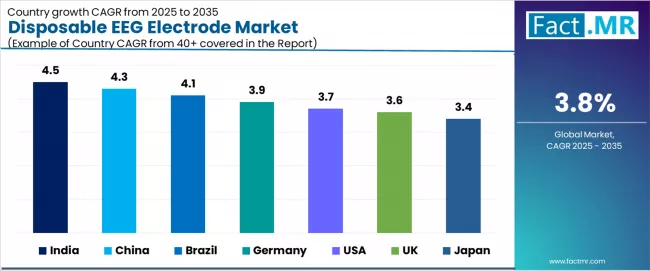
| Country | CAGR (2025-2035) |
|---|---|
| India | 4.5% |
| China | 4.3% |
| Brazil | 4.1% |
| Germany | 3.9% |
| USA | 3.7% |
| UK | 3.6% |
| Japan | 3.4% |
The disposable EEG electrode market is experiencing varied growth globally, with India leading at a 4.5% CAGR through 2035, driven by the expansion of neurology infrastructure development, increasing low-cost EEG production capabilities, and growing domestic demand for affordable disposable electrodes.
China follows at 4.3%, supported by high geriatric population and increasing neurological disorders prevalence. Brazil records 4.1% growth, with a focus on developing rising hospital admissions and increased EEG accessibility.
Germany shows 3.9% growth, representing early adoption of disposable devices to limit hospital-acquired infections. USA demonstrates 3.7% growth, emphasizing large base of neurological cases and infection control standards. The UK records 3.6% growth with NHS investment in neuro-diagnostics, while Japan shows 3.4% growth, representing high aging population and steady replacement demand.
India Demonstrates Exceptional Market Potential with Neurology Infrastructure Expansion
Revenue from disposable EEG electrodes in India is projected to exhibit robust growth with a CAGR of 4.5% through 2035, driven by ongoing neurology department expansion and increasing recognition of affordable disposable electrodes as essential diagnostic components for complex neurophysiological recording processes.
The country’s expanding middle-class healthcare access and growing availability of specialized neurological diagnostic capabilities are creating significant opportunities for disposable electrode adoption across both government and private healthcare facilities.
Major international and domestic medical device companies are establishing comprehensive distribution and technical training networks to serve the growing population of neurologists and diagnostic centers requiring cost-effective disposable electrodes across hospital and clinic applications throughout India’s major healthcare hubs.
The Indian government’s strategic emphasis on healthcare infrastructure modernization and non-communicable disease management is driving substantial investments in specialized neurology capabilities. This policy support, combined with the country’s large epilepsy patient population and expanding neurological care requirements, creates a favorable environment for the disposable electrode market development.
Indian healthcare providers are increasingly focusing on infection control technologies to improve patient safety capabilities, with disposable electrodes representing a key component in this healthcare transformation.
Government initiatives supporting healthcare quality improvement and infection prevention are driving demand for single-use medical devices throughout major neurology and diagnostic centers, including Delhi, Mumbai, and Bangalore regions.
Diagnostic capacity expansion and neurology department development are supporting appropriate utilization of disposable electrodes among hospitals and clinics nationwide, with growth in private multi-specialty hospitals and neurological diagnostic services.
China Demonstrates Strong Market Potential with Aging Population Growth
Revenue from disposable EEG electrodes in China is expanding at a CAGR of 4.3%, supported by increasing geriatric population, growing neurological disorder awareness, and developing healthcare infrastructure presence across the country’s major medical clusters. The country’s large aging population sector and increasing recognition of quality disposable electrodes are driving demand for effective high-performance diagnostic solutions in both hospital and community healthcare applications.
International medical device manufacturers and domestic suppliers are establishing comprehensive distribution channels to serve the growing demand for quality disposable electrodes while supporting the country’s position as an emerging neurodiagnostic technology market.
China’s healthcare sector continues to benefit from favorable medical device policies, expanding neurology capabilities, and cost-competitive manufacturing infrastructure development. The country’s focus on improving healthcare quality standards is driving investments in specialized disposable electrode technology and diagnostic infrastructure. This development is particularly important for electrode applications, as healthcare providers seek reliable domestic sources for critical diagnostic materials to reduce import dependency and improve supply chain security. Rising awareness about infection control options and improving diagnostic capabilities are creating opportunities for specialized disposable electrodes across hospital and clinic settings in major hubs like Beijing, Shanghai, and Guangzhou.
Growing neurology infrastructure development and technology adoption are supporting increased access to quality disposable electrodes among organizations requiring comprehensive diagnostic capabilities, particularly in tertiary care hospitals and specialized neurological centers.
Brazil Maintains Hospital Admission Growth Leadership
Revenue from disposable EEG electrodes in Brazil is projected to exhibit strong growth with a CAGR of 4.1% through 2035, driven by rising hospital admissions and increased EEG accessibility capabilities. T
he country’s expanding healthcare coverage and growing neurology awareness are creating significant opportunities for disposable electrode adoption across both public and private healthcare sectors. Brazilian healthcare companies are leveraging their regional advantages to serve the growing demand for quality disposable electrodes while supporting the country’s position as a Latin American healthcare leader.
The Brazilian market benefits from favorable healthcare expansion policies, increasing neurological disease awareness, and developing diagnostic infrastructure. This development is particularly important for disposable electrode applications, as healthcare providers seek reliable supplies for critical diagnostic materials to maintain quality standards in growing neurology services.
Strategic Market Considerations:
- Hospital neurology and private clinic segments leading growth with focus on infection control and diagnostic quality applications
- Regional healthcare requirements are driving a diverse product portfolio from basic disposable electrodes to advanced signal-optimized systems
- Local manufacturing development supporting competitive pricing in regional markets
- Government healthcare expansion initiatives beginning to influence procurement standards and infection control requirements
Germany Shows Strong Infection Control Leadership
Germany’s market expansion benefits from diverse healthcare demand, including hospital-acquired infection prevention programs and specialized neurology applications that increasingly incorporate disposable electrode solutions for patient safety enhancement.
The country maintains a 3.9% CAGR through 2035, driven by rising infection control awareness and increasing adoption of single-use medical devices, including superior signal quality capabilities and reduced cross-contamination risks.
Market dynamics focus on high-quality disposable electrodes that balance advanced performance features with cost considerations important to German healthcare providers. Growing neurology infrastructure creates demand for modern electrode systems in new diagnostic facilities and equipment modernization projects.
Strategic Market Considerations:
- Hospital neurology and infection control segments leading growth with focus on patient safety and diagnostic excellence applications
- Regional regulatory requirements are driving a diverse product portfolio from standard disposable electrodes to advanced biocompatible systems
- Import dependency for specialty materials offset by domestic medical device manufacturing capabilities
- Government infection prevention initiatives beginning to influence procurement standards and device selection requirements
USA Maintains Neurological Care Leadership
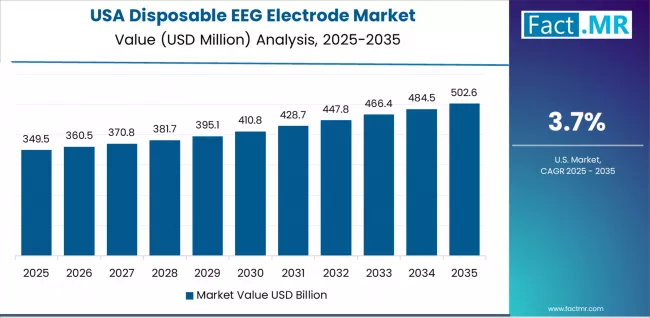
USA’s advanced healthcare technology market demonstrates sophisticated disposable electrode deployment with documented infection control effectiveness in neurology departments through integration with existing diagnostic infrastructure and patient safety systems. The country leverages clinical expertise in neurological case management and infection control standards to maintain a 3.7% CAGR through 2035.
Healthcare centers, including major academic medical centers, showcase premium installations where disposable electrode systems integrate with comprehensive electronic health records and quality monitoring platforms to optimize diagnostic accuracy and patient safety workflow effectiveness.
American healthcare providers prioritize device reliability and infection prevention compliance in neurology development, creating demand for premium disposable electrodes with advanced features, including signal validation and integration with US healthcare quality standards. The market benefits from established neurology infrastructure and a willingness to invest in advanced disposable electrodes that provide long-term patient safety benefits and compliance with CDC infection control guidelines.
Strategic Market Considerations:
- Epilepsy monitoring and intensive care neurology segments leading growth with focus on patient safety and diagnostic precision applications
- Regional infection control requirements are driving a diverse product portfolio from standard disposable electrodes to advanced wireless-compatible systems
- Domestic manufacturing partnerships supporting supply chain security and regulatory compliance
- Government infection prevention initiatives beginning to influence hospital procurement standards and device utilization requirements
UK Demonstrates NHS Investment Excellence
UK’s market expansion benefits from diverse healthcare demand, including NHS neuro-diagnostics investment and specialized epilepsy center applications. The country maintains a 3.6% CAGR through 2035, driven by rising quality awareness and increasing preference for disposable medical devices through public healthcare modernization programs. The market prioritizes advanced features, including signal quality validation and integration with comprehensive diagnostic platforms that reflect UK healthcare expectations for clinical excellence and patient safety.
British healthcare providers focus on value-based procurement strategies in neurology development, creating demand for cost-effective disposable electrodes with advanced features including consistent signal performance and comprehensive clinical documentation. The market benefits from established NHS neurology networks and investment in diagnostic technology that provides long-term patient safety benefits.
Strategic Market Considerations:
- NHS neurology and private epilepsy clinic segments leading growth with focus on infection control and diagnostic quality applications
- Regional healthcare requirements are driving a diverse product portfolio from standard disposable electrodes to premium signal-optimized systems
- Import dependency challenges offset by potential local manufacturing partnerships with international medical device companies
- Government NHS quality initiatives beginning to influence procurement standards and infection prevention requirements
Japan Emphasizes Aging Population and Quality Excellence
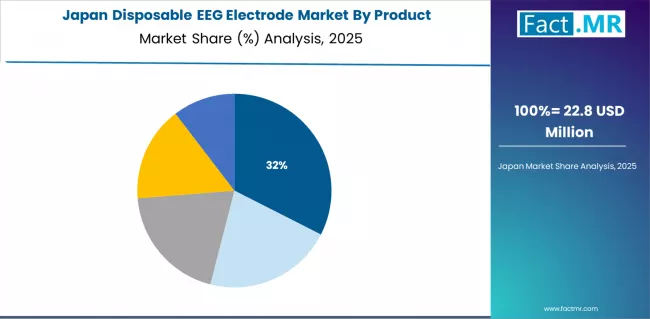
Japan demonstrates steady market development with a 3.4% CAGR through 2035, distinguished by healthcare providers’ preference for high-quality disposable electrodes that integrate seamlessly with existing neurophysiology equipment and provide reliable long-term signal stability in specialized diagnostic applications.
The market prioritizes advanced features, including precision electrode design, biocompatibility validation, and integration with comprehensive quality platforms that reflect Japanese healthcare expectations for technological sophistication and patient comfort excellence.
Japanese neurologists focus on device reliability and signal precision in diagnostic development, creating demand for premium disposable electrodes with advanced features including automated impedance monitoring and comprehensive technical support.
The market benefits from established neurology research infrastructure and investment in advanced diagnostic technology that provides long-term clinical benefits despite the country’s aging demographic challenges.
Strategic Market Indicators:
- Geriatric neurology focus on high-comfort electrodes with advanced biocompatible materials and patient-friendly design
- Integration requirements with existing neurophysiology systems and electronic medical record platforms
- Emphasis on disposable electrode reliability and consistent signal performance in extended monitoring applications
Europe Market Split by Country
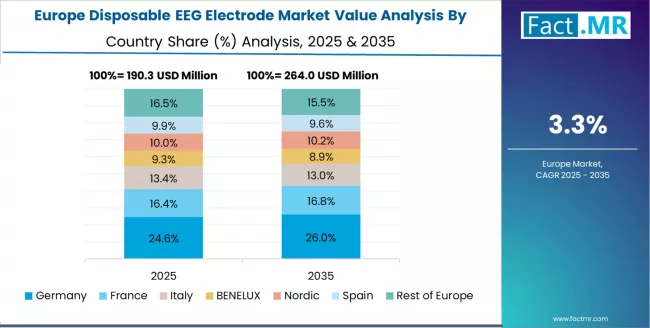
The disposable EEG electrode market in Europe is projected to grow from USD 208.4 million in 2025 to USD 301.5 million by 2035, registering a CAGR of 3.8% over the forecast period. Germany is expected to maintain its leadership position with a 35.6% market share in 2025, rising to 36.2% by 2035, supported by its advanced neurology infrastructure, stringent infection control protocols, and strong healthcare system presence throughout major medical regions.
The UK follows with a 28.9% share in 2025, projected to reach 29.4% by 2035, driven by NHS investment in neuro-diagnostics and comprehensive infection prevention programs serving both public and private healthcare sectors. France holds a 24.3% share in 2025, expected to increase to 24.7% by 2035, supported by neurology department expansion and growing adoption of disposable medical devices. Italy commands a 11.2% share in 2025, projected to decline slightly to 9.7% by 2035, attributed to healthcare budget constraints and slower adoption of premium single-use devices.
The rest of Europe region, including Nordic countries, Eastern Europe, and smaller Western European markets, is anticipated to experience gradual consolidation as healthcare providers prioritize established suppliers with proven clinical performance and comprehensive regulatory compliance capabilities for patient safety-critical applications.
Competitive Landscape of the Disposable EEG Electrode Market
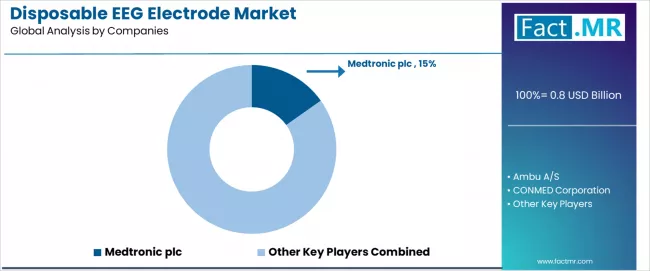
The disposable EEG electrode market is characterized by competition among established medical device manufacturers, specialized neurophysiology companies, and diagnostic technology suppliers focused on delivering high-quality, consistent, and safe disposable electrode products.
Companies are investing in electrode material technology advancement, signal quality enhancement, strategic partnerships with neurology departments, and clinical technical support to deliver effective, reliable, and patient-friendly disposable electrode solutions that meet stringent healthcare safety and neurophysiological performance requirements. Product design optimization, clinical validation protocols, and regulatory compliance strategies are central to strengthening product portfolios and market presence.
Medtronic plc leads the market with a 15.2% share, offering comprehensive high-quality disposable electrode solutions with a focus on signal consistency and patient safety for neurological diagnostic applications. The company’s extensive product portfolio spans needle, cup, and patch electrode systems with advanced biocompatible materials and global clinical support capabilities.
Ambu A/S holds 13.4% market share, providing specialized single-use neurophysiology products with emphasis on infection prevention and comprehensive clinical training services, leveraging its expertise in disposable medical device innovation. CONMED Corporation commands 11.8% share, focusing on advanced electrode technologies and customized neurophysiology solutions for surgical and intensive care systems serving global healthcare markets.
Natus Medical Incorporated delivers established neurodiagnostic systems with 10.9% market share, featuring strong integration capabilities with proprietary EEG amplifier systems and comprehensive customer service infrastructure across North American and European hospitals. Brain Scientific Inc. operates with 9.7% share, bringing innovative portable EEG technologies and disposable electrode solutions to point-of-care applications and emerging markets, particularly in emergency department and telemedicine segments.
BIOPAC Systems Inc. provides 8.2% market share through research-grade electrode systems optimized for clinical trials and academic neuroscience applications. Nihon Kohden Corporation holds 7.5% share, specializing in high-precision electrode manufacturing for Japanese and Asian healthcare markets with emphasis on quality control and regulatory compliance.
Rhythmlink International LLC commands 6.8% market share, providing specialized intraoperative monitoring electrodes for neurosurgical applications with focus on surgical neurophysiology. Cadwell Industries Inc. holds 5.6% share, focusing on integrated neurodiagnostic systems with proprietary disposable electrode technologies for epilepsy monitoring units.
NeuroWave Systems Inc. maintains 4.9% market presence, delivering innovative wireless EEG electrode systems for ambulatory monitoring and home-based neurological assessment. The competitive landscape is characterized by ongoing investments in biocompatible adhesive technologies, wireless electrode integration capabilities, and biodegradable material innovations as companies position themselves to capitalize on infection control trends and patient safety requirements driving market evolution.
Key Players in the Disposable EEG Electrode Market
- Medtronic plc
- Ambu A/S
- CONMED Corporation
- Natus Medical Incorporated
- Brain Scientific Inc.
- BIOPAC Systems Inc.
- Nihon Kohden Corporation
- Rhythmlink International LLC
- Cadwell Industries Inc.
- NeuroWave Systems Inc.
Scope of the Report
| Items | Values |
|---|---|
| Quantitative Units (2025) | USD 0.79 billion |
| Product | Needle Electrode, Cup Electrode, Patch Electrode, Disk Electrode, Others |
| Application | Diagnostic, Therapeutic, Research & Clinical Trials |
| End Use | Hospitals, Clinics, Others |
| Regions Covered | North America, Europe, Asia Pacific, Latin America, Middle East & Africa |
| Countries Covered | USA, Germany, China, Japan, India, Brazil, UK and 40+ countries |
| Key Companies Profiled | Medtronic plc, Ambu A/S, CONMED Corporation, Natus Medical Incorporated, Brain Scientific Inc., BIOPAC Systems Inc., Nihon Kohden Corporation, Rhythmlink International LLC, Cadwell Industries Inc., and NeuroWave Systems Inc. |
| Additional Attributes | Dollar sales by product and application, regional demand trends, competitive landscape, neurologist preferences for specific electrode designs, integration with specialized neurophysiology equipment supply chains, innovations in electrode materials and adhesive technologies, signal quality monitoring, and patient safety optimization |
Disposable EEG Electrode Market by Segments
-
Product:
- Needle Electrode
- Cup Electrode
- Patch Electrode
- Disk Electrode
- Others
-
Application :
- Diagnostic
- Therapeutic
- Research & Clinical Trials
-
End Use :
-
Region :
- North America
- Europe
- Germany
- UK
- France
- Italy
- Spain
- Nordic
- BENELUX
- Rest of Europe
- Asia Pacific
- China
- India
- Japan
- South Korea
- ASEAN
- Australia & New Zealand
- Rest of Asia Pacific
- Latin America
- Brazil
- Argentina
- Chile
- Rest of Latin America
- Middle East & Africa
- Kingdom of Saudi Arabia
- Other GCC Countries
- Turkey
- South Africa
- Other African Countries
- Rest of Middle East & Africa
- North America
link