


Post-Industrial Recyclate (PIR) Flexible Packaging Market Forecast and Outlook 2026 to 2036
The global post-industrial recyclate (PIR) flexible packaging market is valued at USD 1.48 billion in 2026 and is projected to reach USD 3.05 billion by 2036, expanding at a CAGR of 7.5% over the decade. In 2026, the Snacks, Confectionery & Food application segment is estimated to hold a 40% share, while PIR-based Laminated Pouches constitute 45% by packaging format and PIR-PE, PIR-PP leads material adoption with a 50% share.
Key Takeaways from the Post-Industrial Recyclate (PIR) Flexible Packaging Market Report
- Market Value (2026): USD 1.48 Billion
- Market Forecast Value (2036): USD 3.05 Billion
- Forecast CAGR (2026-2036): 7.5%
- Leading Application Segment: Snacks, Confectionery & Food (40%)
- Leading Packaging Format: PIR-based Laminated Pouches (45%)
- Leading Material: PIR-PE, PIR-PP (50%)
- Leading Technology: Advanced Re-melt Filtration & PIR-optimised Extrusion (50%)
- Key Growth Regions: North America, Latin America, Europe, Asia Pacific, MEA
- Key Players: Amcor plc, Mondi plc, Greenpack Packaging, Berry Global, Sealed Air Corporation, Huhtamaki Oyj, The Hengli Group
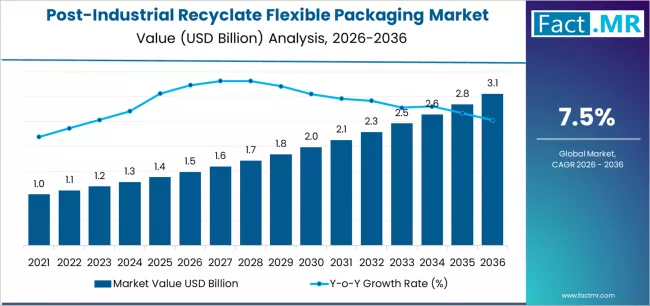

Stringent brand commitments to incorporate recycled content and the economic advantage of utilizing pre-consumer waste streams are the primary drivers of market growth. Facing regulatory pressure and consumer demand for sustainable packaging, brands are turning to PIR, high-quality recycled material from manufacturing scrap,as a reliable and consistent way to meet recycled content targets without compromising on performance. This shift leverages the existing industrial circular economy, transforming trim waste and off-spec production directly back into new packaging, thereby reducing reliance on virgin plastics and lowering the carbon footprint of flexible films and pouches.
Advancements in purification and processing technologies are critical to market expansion. Innovation in advanced re-melt filtration and PIR-optimized extrusion is overcoming historical challenges related to odor, color, and contamination, enabling the production of high-clarity, food-safe films suitable for demanding applications. These technological enhancements allow PIR-based flexible packaging to move beyond simple liners into high-value, printed laminated structures for mainstream consumer goods.
Post-Industrial Recyclate (PIR) Flexible Packaging Market
| Metric | Value |
|---|---|
| Estimated Value in (2026E) | USD 1.48 Billion |
| Forecast Value in (2036F) | USD 3.05 Billion |
| Forecast CAGR (2026 to 2036) | 7.5% |
Category
| Category | Segments |
|---|---|
| End-use/Application | Snacks, Confectionery & Food, Pet Food & Personal Care, E-commerce & FMCG, Household & Value FMCG, Others |
| Packaging Format/Type | PIR-based Laminated Pouches, Flow-wrap Films, Mono-PE PIR Films, PIR-based mailer films & courier pouches, Small-format PIR pouches, Others |
| Material | PIR-PE, PIR-PP, PIR Mono-PE Structures, PIR-PE blends, PIR-PE, Others |
| Technology | Advanced Re-melt Filtration & PIR-optimised Extrusion, Solvent-free PIR Compatibilisation, High-speed PIR Reprocessing, Low-cost PIR Extrusion Systems, Others |
| Region | North America, Europe, Asia Pacific, Latin America, MEA |
Segmental Analysis
Why does Snacks, Confectionery & Food drive the leading Application Segment?
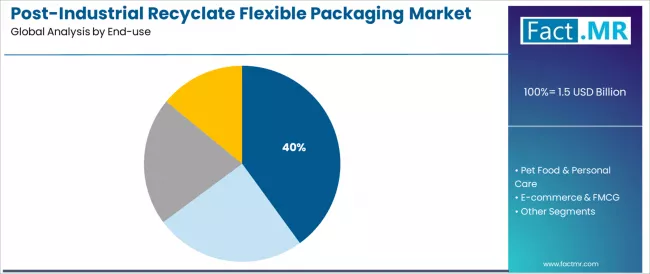
Snacks, confectionery & food will command a 40% share, fueled by the sector’s immense volume, high packaging visibility, and intense pressure to improve sustainability profiles. Brands in this competitive space utilize PIR-based flexible packaging to achieve significant reductions in virgin plastic use and lifecycle emissions, which can be prominently communicated on-pack to eco-conscious consumers. The consistent quality and supply of PIR make it a dependable choice for high-speed filling lines and critical barrier requirements for food preservation.
- Major snack and confectionery brands are setting ambitious public targets for recycled content, creating a top-down demand pull for PIR solutions from their packaging suppliers.
- The ability to incorporate PIR into high quality, multi-layer laminated structures allows for the maintenance of essential barriers against moisture and oxygen, protecting product freshness while meeting sustainability goals.
What establishes PIR-based Laminated Pouches as the dominant Packaging Format?
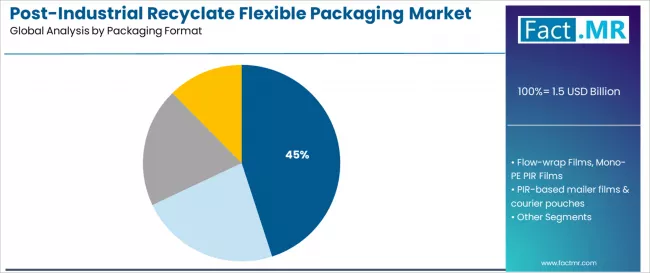
PIR-based Laminated Pouches hold a 45% share as they represent the most value-added and technically advanced application of PIR materials. These pouches combine the sustainability benefit of recycled content with the premium aesthetics, durability, and high-performance barriers required for branded food and personal care products. The format demonstrates that PIR can be successfully integrated into complex structures, dispelling perceptions that recycled content is only suitable for low-grade packaging.
- Innovation focuses on optimizing layer structures to maximize PIR content in the bulk layers while maintaining pristine virgin polymer in critical sealing and contact layers for safety and performance.
- This format is crucial for brand storytelling, allowing for high-quality printing that communicates the recycled content narrative directly on the shelf, enhancing consumer perception.
What solidifies PIR-PE, PIR-PP as the preferred Material choice?
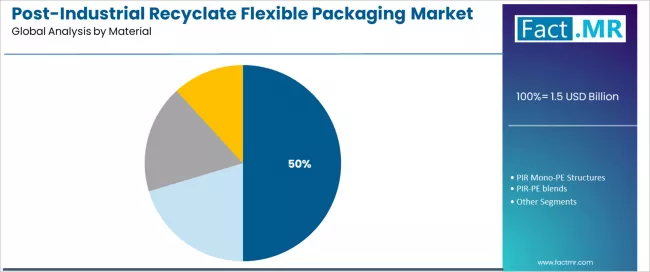
PIR-PE, PIR-PP leads with a 50% share, directly benefiting from the massive existing waste streams of PE, PP trimmings, and off-spec film from the flexible packaging converting industry itself. These materials have well-established recycling pathways and, when processed with advanced filtration, can achieve clarity and purity levels suitable for a wide range of applications. Their versatility forms the backbone of the PIR market.
- PIR-PE is dominant in applications requiring flexibility and sealability, such as pouches and liners, while PIR-PP is favored for its stiffness and clarity in flow-wrap and rigid laminates.
- The development of specialized compatibilizers allows for the creation of high-performance PIR blends, expanding the potential applications and improving the mechanical properties of the final film.
What are the Drivers, Restraints, and Key Trends in the Post-Industrial Recyclate (PIR) Flexible Packaging Market?
Corporate ESG targets mandating specific percentages of recycled content in packaging, with PIR offering a compliant, traceable, and quality-assured solution, decisively drive the market. The economic incentive of using lower-cost PIR material compared to virgin polymer, especially under volatile resin markets, provides a strong financial driver for converters and brands.
A primary restraint is the finite supply of high-quality, food-grade PIR feedstock, which is limited by the efficiency and waste generation of converting operations. There is also a technical challenge in achieving consistent color and clarity in PIR films for brand-sensitive applications. The market is trending towards closed-loop partnerships between large brand owners and their dedicated converters, where manufacturing scrap is systematically collected, reprocessed, and fed back into dedicated packaging lines for the same brand. Furthermore, advanced filtration and decontamination technologies are key, focusing on removing microscopic contaminants and volatiles to produce odor-free, high-purity PIR suitable for sensitive food contact applications.
Analysis of the Market by Key Countries
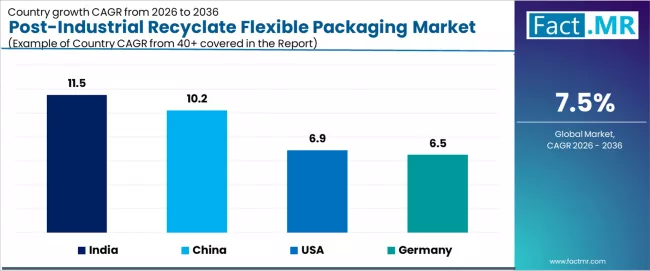
| Country | CAGR (2026-2036) |
|---|---|
| USA | 6.90% |
| Germany | 6.50% |
| China | 10.20% |
| India | 11.50% |
What underpins steady adoption in the USA’s market?
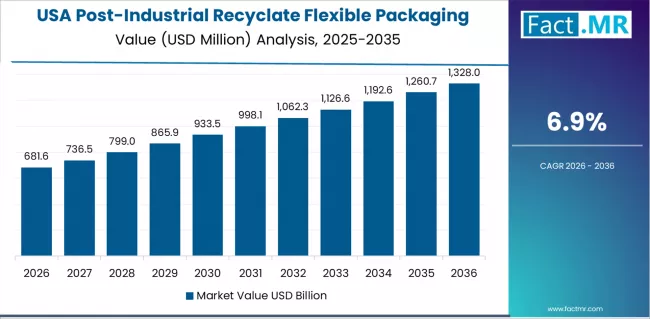
Growth in the USA at a 6.90% CAGR is anchored in strong brand-led initiatives and a mature recycling infrastructure for industrial plastics. Major CPG (Consumer Packaged Goods) companies are integrating PIR to meet voluntary recycled content pledges. The market is characterized by investments in advanced near-infrared (NIR) sorting and filtration technology to upgrade PIR quality for food-grade applications.
How does Germany’s regulatory framework shape its market?
Germany’s 6.50% CAGR reflects a market driven by the EU’s circular economy action plan and stringent packaging laws (VerpackG), which incentivize the use of recycled materials. German engineering excellence is applied to developing ultra-efficient, low-energy PIR reprocessing lines and solvent-free compatibilization technologies to maintain material integrity through multiple lifecycles.
What factors propel China’s rapid expansion?
China’s 10.20% CAGR is fueled by its position as the world’s largest manufacturing hub, generating vast volumes of post-industrial plastic waste. National sustainability policies and corporate commitments from large exporters are accelerating the adoption of PIR to reduce environmental impact. Domestic giants are investing heavily in high-volume, high-speed PIR reprocessing to supply both local and global supply chains.
Why does India exhibit the highest growth trajectory?
India leads with an 11.50% CAGR, driven by the explosive growth of its FMCG and e-commerce sectors, coupled with a strong national focus on waste management and plastic reduction. The market demands highly cost-competitive PIR solutions. Localized, agile converters implementing low-cost PIR extrusion systems to supply mailer bags, courier pouches, and value FMCG packaging, turning local industrial waste into affordable packaging, fuel growth.
Competitive Landscape
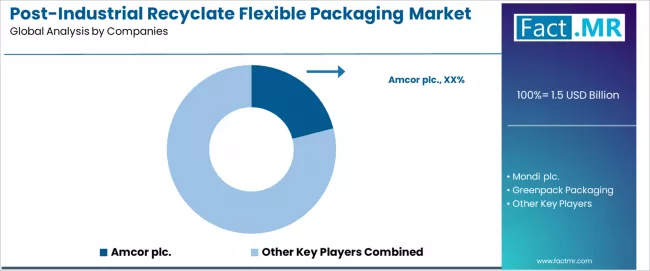
The competitive landscape is defined by integrated global packaging leaders and specialized regional converters. Global players like Amcor, Mondi, and Berry Global leverage their scale, in-house recycling capabilities, and deep R&D to produce high-performance PIR-based films and offer closed-loop solutions to multinational brands.
Regional specialists and local converters like Greenpack Packaging compete on agility, cost-optimization for specific local waste streams, and the ability to serve fast-growing domestic markets in Asia and Latin America. Competition hinges on securing long-term supply agreements for quality PIR feedstock, mastering advanced purification technologies, and providing brand customers with certified documentation of recycled content and reduced carbon footprint.
Key Players Profiled in the Post-Industrial Recyclate (PIR) Flexible Packaging Market
- Amcor plc
- Mondi plc
- Greenpack Packaging
- Berry Global
- Sealed Air Corporation
- Huhtamaki Oyj
- The Hengli Group
Scope of the Report
| Items | Values |
|---|---|
| Quantitative Units (2026) | USD 1.48 Billion |
| End-use/Application | Snacks, Confectionery & Food, Pet Food & Personal Care, E-commerce & FMCG, Household & Value FMCG, Others |
| Packaging Format/Type | PIR-based Laminated Pouches, Flow-wrap Films, Mono-PE PIR Films, PIR-based mailer films & courier pouches, Small-format PIR pouches, Others |
| Material | PIR-PE, PIR-PP, PIR Mono-PE Structures, PIR-PE blends, PIR-PE, Others |
| Technology | Advanced Re-melt Filtration & PIR-optimised Extrusion, Solvent-free PIR Compatibilisation, High-speed PIR Reprocessing, Low-cost PIR Extrusion Systems, Others |
| Regions Covered | North America, Europe, Asia Pacific, Latin America, Middle East & Africa |
| Key Companies Profiled | Amcor plc, Mondi plc, Greenpack Packaging, Berry Global, Sealed Air Corporation, Huhtamaki Oyj, The Hengli Group |
| Additional Attributes | PIR feedstock supply chain analysis, cost comparison of PIR vs. virgin resin, technical analysis of filtration systems, brand case studies on closed-loop implementation. |
Post-Industrial Recyclate (PIR) Flexible Packaging Market by Segments
-
By End-use/Application :
- Snacks, Confectionery & Food
- Pet Food & Personal Care
- E-commerce & FMCG
- Household & Value FMCG
- Others
-
By Packaging Format/Type :
- PIR-based Laminated Pouches
- Flow-wrap Films, Mono-PE PIR Films
- PIR-based mailer films & courier pouches
- Small-format PIR pouches
- Others
-
By Material :
- PIR-PE, PIR-PP
- PIR Mono-PE Structures
- PIR-PE blends
- PIR-PE
- Others
-
By Technology :
- Advanced Re-melt Filtration & PIR-optimised Extrusion
- Solvent-free PIR Compatibilisation
- High-speed PIR Reprocessing
- Low-cost PIR Extrusion Systems
- Others
-
By Region :
-
North America
-
Europe
- Germany
- UK
- France
- Italy
- Spain
- Nordic Countries
- BENELUX
- Rest of Europe
-
Asia Pacific
- China
- India
- Japan
- South Korea
- Australia
- Rest of Asia Pacific
-
Latin America
- Brazil
- Argentina
- Rest of Latin America
-
Middle East & Africa
- Saudi Arabia
- UAE
- South Africa
- Rest of MEA
-
link