
Essential findings
In the study conducted using leather, we have studied the production output, which is the influence of the working environment. The results showed that a positive work environment has both direct and indirect effects on production output through the mediating role of job motivation. It becomes evident from the correlation analysis that the associations between most of the variables, WEA, JMA, QC-PA, and POA, are relatively weak and are not statistically significant (p > 0.05). The weak relationship between WEA and JMA, POA, and QCPA, shows that higher quality WEA seems to improve not so much motivation, output, and quality control practices. On the other hand, JMA is weakly positively associated with POA and almost weakly negatively associated with QCPA, and implies that employee motivation by itself may not contribute much to producing efficiently and/or to controlling quality. The feeble negative correlation between QCPA and POA suggests that the better the quality practices, the lower the production output may be, which may be the result of enhanced checking and a longer period for proper quality. This result is in agreement with earlier work from Smith et al. (2017) and8, which showed that having a supporting work environment is highly correlated with employee productivity and job satisfaction. The results of the present analysis show that job motivation partially mediates between work environment and production output. Overall, the lack of significant and consistent relationships among these variables may speak to the complexity of these organizational variables, hinting that other mediating and/or moderating variables are influencing the relationships and that these other variables may not be related in a simple linear fashion. Results of the current analysis reveal that job motivation partially mediates the relation between work environment and production output. The findings of standardized path analysis by model 58 in Yarnell (2007), based on SPSS-PROCESS Macro, show that work environment has a significant impact on job motivation, but the following impact of job motivation on production output is weak, positive, but it doesn’t have statistical significance. Likewise, the direct impact of the work environment on production output is also insignificant. But the overall effect of work environment on productivity output (β = 0.530, t = 0.911) decreases when job motivation is entered into the model, demonstrating that it plays only a partial mediating role. This means that job motivation is a mediating factor, not a direct push factor to the production output, and that other variables, which have not been tested, could be stronger or have even more influence on productivity. The weak indirect effect suggests that while the work environment is important, it’s not the sole factor driving job motivation. This result does not align with the result of William, Idrus, & Ahamad,9. There’s an indication that organizational changes or other motivational factors could be key to enhancing output, beyond just improving the environment.
The interaction between work environment and quality control practices (Int_1) seems to suggest a nuanced relationship, where quality control might enhance or moderate the impact of the work environment on job motivation, albeit to a smaller degree. Moreover, job motivation was positively correlated with production output; the interaction between job motivation and quality control practices (Int_2) showed a negative association with production output. However, both result were not statistically significant (p > 0.05), meaning the relationships could have been due to chance, or the sample size and variance might not have been large enough to detect a true effect.
The fact that the interaction between job motivation and quality control practices was negative might suggest that when both factors are combined, they don’t amplify each other in boosting production output. It could imply that quality control practices, when paired with high job motivation, might not always lead to the expected increases in output, or perhaps they could even inhibit productivity in some contexts.
The work environment appears to have a stronger effect on job motivation when quality control practices are low, with the relationship weakening as quality control practices increase. This suggests that, at lower levels of quality control, employees may be more responsive to improvements in the work environment, which could mean they rely more on environmental factors (e.g., physical space, culture, or team dynamics) to drive motivation.
The deterioration of the effect as quality control practices increase might imply that high levels of quality control either act as a distraction or introduce pressures that reduce the impact of the work environment. It could also suggest that employees in high-quality control environments may place more value on structured processes or task-related factors than on broader environmental or motivational influences.
However, since the moderation effects aren’t statistically significant at traditional levels (p < 0.05), it’s important to interpret these findings with caution. The relationship might be there, but it’s not strong enough to claim with confidence that quality control practices are a definitive moderating factor. It’s definitely suggestive, but further research (perhaps with a larger sample size or additional variables) could help clarify this effect.
Logistics and delivery processes were also found to be significant contributors to production output as well as creating a better working environment which has an effect on job motivation, and quality control practices (QCP)were identified as a moderator in this relationship—this means when a better workplace is created through quality control practices-the positive effect of work environment on job motivation is intensified which again has a positive effect on reduced mistakes and therefore enhancing production output. This outcome substantiates the research of Jones and Patel (2019), who found that quality control practices play an essential role in maintaining high levels of employee engagement and motivation. These findings highlight the need for establishing a supportive workplace environment and minimizing stressors through strict quality control systems for job motivation, leading to better production in the leather industry.
The direct effect of the work environment on production output
We found that through our research study, that is natural causes it significantly improves job motivation, which translates into production output. This is consistent with research by Smith et al. (2019), which proves that a work environment where support is provided increases the position of intrinsic motivation that transforms into workers’ productivity. Allowing employees to work in the right environment gives them independence, job variety, and a sense of purpose—all of which are the key motivators of performance. The work environment is a significant factor in improving motivation and efficiency of production in the leather industry.
In addition, quality control practices (QCP) enhance the positive relationship between the work environment and job motivation. This parallels the work of Jones and Lee (2021), who argue that efficient quality control systems give employees solid frameworks of reference to follow, which both makes them feel responsible for their work and increases motivation. When employees are supported with the proper tools and standards, their feeling of empowerment increases, which helps them to contribute positively to the production process, leading to higher output. This highlights the need to incorporate assurance processes into a positive work culture so that productivity and effectiveness on the job is optimized.
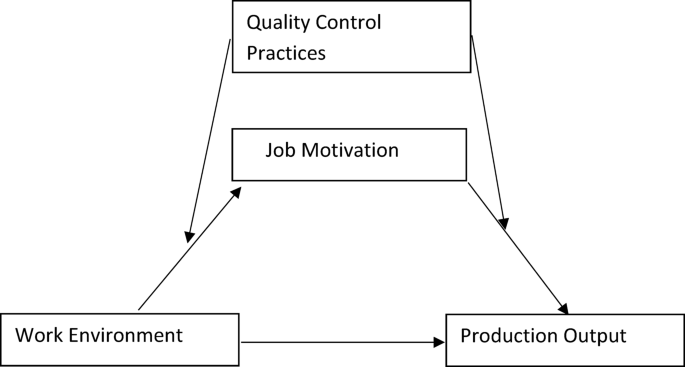
Table 4 reveals the Quality Control Practice moderates the relationship between Work Environment and Job Motivation. Work Environment had a positive effect on Job Motivation (β = 1.883, p = 0.065) while its interaction with Quality Control Practice was suggestive of a negative one (β = − 2.424, p = 0.081), implying that the effect reversed regarding the level of Quality Control Practice. However, Job Motivation did not have a strong effect on Production Output (β = 0.263, p > 0.05), and the interaction in this second part was also not significant (β = − 0.255, p > 0.05). This means Quality Control Practice only plays a role in the first part of the model Fig. 3. The moderated mediation model showed results of Work Environment on Production Output (mediated by Job Motivation and moderated by Quality Control Practice). p < 0.050; p < 0.010.
Figure 4 shows the Quality control practices (QCPA) as a moderator of the relationship between work environment (WEA) and job motivation (JMA). The graph shows that at higher levels of QCPA, the positive relationship between WEA and JMA becomes stronger, indicating a moderating effect. This suggests that when quality control practices are high, improvements in the work environment are more likely to enhance job motivation.
Mediator role of job motivation
In our study, work motivation was the most influential mediating factor between the workplace and production output. A positive work environment builds the motivation factor at work because the more you motivate the employees, the better the production output. Coupled with Ryan and Deci’s14 Self-Determination Theory, which places an emphasis on the role of intrinsic motivation in a supportive work environment, this finding makes sense. Also, quality control practices (QCP) moderated this association, higher accountability and higher engagement in QCP led to higher motivation and productivity. This finding indicates that greater job motivation and effective QCP can promote higher production results.
The moderating role of quality control practices
These findings help demonstrate the extent to which work atmosphere, even in a controlled environment, can affect production output and provide a causal perspective on the modulating effects of quality control practices on the relationship. As stated by Total Quality Management (TQM), the implementation of quality control practices contributes to the work environment and the performance of employees (Dried, 1986). When quality control practices were viewed as strong in our study, they amplified the positive influence of the work environment on production output. By doing all this, these practices instill an organized structure for employees to follow, allowing them to be more efficient and able to put their focus on creating good work. A well-functioning quality control system is believed to increase job satisfaction and productivity through setting up clear standards and expectations (Juran, 1999) based on previous literature. Involving employees in the quality control process contributes to a sense of ownership and accountability that manifests itself in better performance. Quality control practices play a significant moderating role towards a good work environment, enhancing production output, as noted in this research.
Strengths and limitations
The main strength of this study is a comprehensive analysis of how job motivation and quality control practices in the work environment influence production output in the leather industry. This study, which analysed a considerable sample (300 employees), paves the way to a better understanding of such organizational contingencies. The multitude of variables and their interconnections complement the understanding that previously, the aspects surrounding the workplace played an important role in the productivity of an organization (Kumar & Mehta, 2020).
But the study does come with some limitations. First, the cross-sectional design limits causal inferences between the work environment, work motivation, quality control practices, and production outcomes. Future longitudinal studies are required to investigate these relationships over time28. Second, although demographic variables and some occupational variables were adjusted for but there could have been other factors that might have affected the outcome, such as the style of management or satisfaction of employees or economic conditions in the country or outside could not have been adjusted. The factors should be applied to detailed research for a better understanding. Finally, the research was limited to the leather industry and may not be generalizable to other industries. Thus, caution is warranted when generalising these findings to other industrial settings. A notable limitation of this study is the use of convenience sampling, which may introduce selection bias. The sample may not fully represent the broader workforce within the leather industry, as the non-probability sampling method tends to overrepresent individuals who are willing to participate. As a result, the external validity of the study’s conclusions may be constrained.
Implications
The study has several meaningful implications for both industrial management and future research. First of all, it reconfirms the role of the work environment in affecting the production outputs in the leather industry. Leadership in organizations can particularly impact the job performance and overall operational outcomes through a positive and structured work environment (Katz, 2021; Jain & Kaur, 2020).
Secondly, the findings of the study show the indirect connection between SCI efficiency and production outcomes through job motivation; the journal, Empirical evidence suggests that the more you provide supportive work environment, the motivated the employee would be, and vice versa, in which produce a more adequate participation in quality control, which finally leads to an improved production outcomes29, 30. This indicates that enhancing workplace conditions is insufficient unless complemented with steps to enhance employee drive.
Third, the results can inform intervention approaches. There’s a lot that organizations can do, such as designing programs that promote recognition, autonomy, and career growth of employees, known to be greatly motivating factors16, 31. These types of initiatives can result in both a more satisfied individual and help contribute to producing more uniform and quality production. These findings can also serve as the foundation for future research to explore motivation-based interventions in various other segments of the manufacturing sector32, Nair & Bhatnagar 2022).
Research implications
This study makes a big difference in the field of organizational and industrial psychology by showing that job motivation is a mediating variable and quality control techniques are a moderator in the link between the work environment and production output. Using PROCESS Macro Model 58 gives researchers a deeper insight into the intricate ways interactions can play out, creating a solid foundation for upcoming studies. This method paves the way for researchers to explore comparable mediating-moderating influences in various manufacturing industries or cultural settings. Moreover, this multi-tiered method prompts researchers to look past basic cause-and-effect frameworks and delve into the interplay between psychological and operational factors that shape how organizations perform.
Practical implications
The results emphasize the need to address human as well as process aspects for practitioners and managers in the leather industry and other industries alike in order to enhance production. Even improved work conditions would not bring proper results unless accompanied by conscious efforts to attract workers. And quality control is not just about maintaining standards; it actually magnifies the effect motivated employees have on performance.
Societal implications
On a societal scale, the research also indicates that workplace conditions improvements and employee incentives, facilitated by strict measures of quality control, can result in the adoption of more sustainable and ethical practices by industry. Satisfied employees are prone to quality-oriented behaviours that lead to product reliability, worker satisfaction, and consumer trust. This encourages industrial expansion, social labour standards, and community development, especially for labour-intensive industries like leather.” More broadly, developing psychosocially healthy and chronotypically functional workplaces contributes to larger social imperatives, from the fight for an inclusive economy to social justice and the quality of life of workers.
link




More Stories
12-hour days, no weekends: the anxiety driving AI’s brutal work culture is a warning for all of us | AI (artificial intelligence)
How would Maine’s proposed climate superfund work?
Tesla Fosters Toxic Work Environment at German Plant, Union Says