

With property taxes and education at the top of Gov. Mike Braun’s agenda, environmental laws have taken a backseat in the Indiana Statehouse this session. But organized water resource management, nuclear energy and polyfluoroalkyl substances (PFAS) still find themselves areas of interest in the Senate and House.
With bills already introduced, these are the legislators who could be at the front of Indiana’s latest environmental laws.
Rep. Beau Baird, R-Greencastle
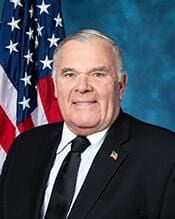
U.S. Rep. Jim Baird, R-Indiana.
Chair of the House Committee for Environmental Affairs, Rep. Beau Baird, R-Greencastle, left the House Ways and Means Committee for the role and is a current member of the House Agriculture Committee and House Rules and Legislative Procedure Committee. He is chief financial officer of Indiana Home Care Plus with an executive MBA in business administration and management from Purdue University. He also owns and operates Baird Ranch.
“Beau has demonstrated a keen understanding of environmental issues and a commitment to preserving Indiana’s natural resources while embracing economic growth,” House Speaker Rep. Todd Huston, R-Fishers, said when first announcing Baird’s position on the committee. “His background and expertise position him well.”
What has he been up to in the first month of the 2025 legislative session? Baird has authored two environmental bills. House Bill 1661 would initiate the Landowner Forest Management Program. It would require the Indiana Department of Agriculture to collect data concerning the loss of Indiana forest land from 2010 to 2024 and do an economic impact study.
Baird’s House Bill 1556 would grant veterans with identification free admission into any Indiana state park.
Both bills were referred to the House Natural Resources Committee on Jan. 21.
Sen. Susan Glick, R-LaGrange
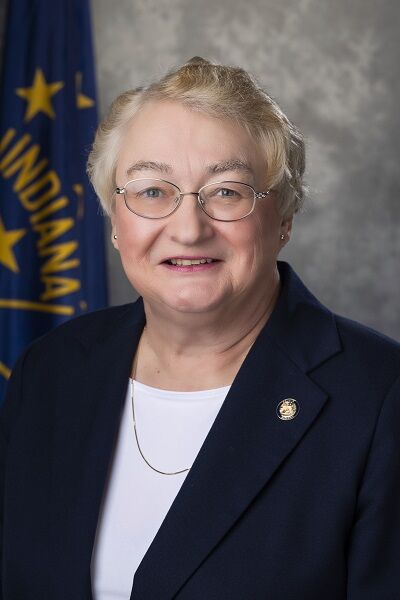

Sen. Sue Glick, R-LaGrange.
Sen. Susan Glick, R-LaGrange, is the standing chair of the Senate Committee on Natural Resources. She’s been in the Statehouse since 2010 and is serving as the LaGrange County prosecuting attorney. Glick is also the assistant president pro tempore.
She has a doctor of law and a bachelor of arts in political science from Indiana University.
The first month of this session she has authored three environmental bills.
Senate Bill 211—authored by Glick, Jean Leising, R-Oldenburg, and Brett Clark, R-Avon—would allow dollars from the Clean Water Indiana Program to be used for the management of invasive species plants. It passed unanimously in the Senate and has been referred to the House.
Authored with Sen. Eric Koch, R-Bedford, and Sen. Chris Garten, R-Charlestown, Senate Bill 4 has a focus on improving Indiana’s water management. It would require a certificate of public convenience and necessity from the Indiana Utility Regulatory Commission for large-scale water pipeline projects. A permit from the Indiana Department of Natural Resources would be required for transfers of over 30,000,000 gallons of water a day. It also unanimously passed the Senate and has been referred to the House.
Carbon dioxide sequestration—a process in which carbon dioxide emissions are stored, most commonly underground, as a method of reducing the major greenhouse gas—has also found itself a topic of one of Glick’s bills.
Senate Bill 457 would allow companies to apply for and purchase certificates for the construction of carbon dioxide transmission pipelines, and storage operators would need to pay the DNR $0.08 per metric ton of carbon dioxide stored. It passed the Senate Tuesday.
Senate Bill 32 has a focus on combating chronic wasting disease, a “fatal neurological disease affecting white-tailed deer” first found in the state in April 2024. It’s been with the Committee on Natural Resources since Jan. 8.
The bill would establish a pilot program with the Department of Natural Resources that would collect DNA samples and identify white-tailed deer that are genetically resistant to the disease. The resistant individuals would then be bred to increase the survival rate within Indiana’s deer population.
Sen. Eric Koch, R-Bedford
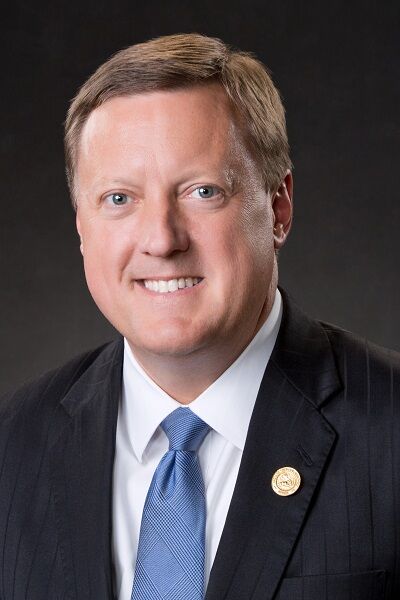
Sen. Eric Koch, R-Bedford.
Since the LEAP pipeline project, Indiana legislators have been aware of the importance of proper water management.
Sen. Eric Koch, chair of the Senate Utilities Committee, has proved his interest, authoring Senate Bill 4 on water management with Glick and authoring Senate Bill 426.
SB 426 would require the Indiana Utility Regulatory Commission to ensure that an acquisition of water/wastewater utilities is reasonable and of benefit to the public. It passed the Senate Tuesday.
Koch has also authored bills related to nuclear energy.
Senate Bill 423 would establish the Small Modular Nuclear Reactor Partnership Program, supporting nuclear energy, which is a cleaner energy source. It passed the Senate and was referred to the House on Feb. 4.
Koch has also authored Senate Bill 424, which would allow companies to petition the Indiana Utility Regulatory Commission to gather funds for the purpose of constructing small modular nuclear reactors. This also passed the Senate and was referred to the House on Feb. 4.
A final bill: Senate Bill 178 would define natural gas and propane as “clean energy,” qualifying them for state or federal benefits and dollars. SB 178 passed the Senate Utilities Committee on Feb. 6 but has not yet received a second reading in the chamber.
Koch’s background includes a membership in the National Conference of State Legislatures Energy Supply Task Force, the Indiana Geological and Water Survey Advisory Council, and the National Council on Electricity Policy’s Executive Committee.
Currently an attorney, Koch has a doctor of law from Indiana University, a graduate certificate in energy policy planning from the University of Idaho, and a certificate from the Community Bank Directors Program at Southern Methodist University.
Sen. Rick Niemeyer, R-Lowell
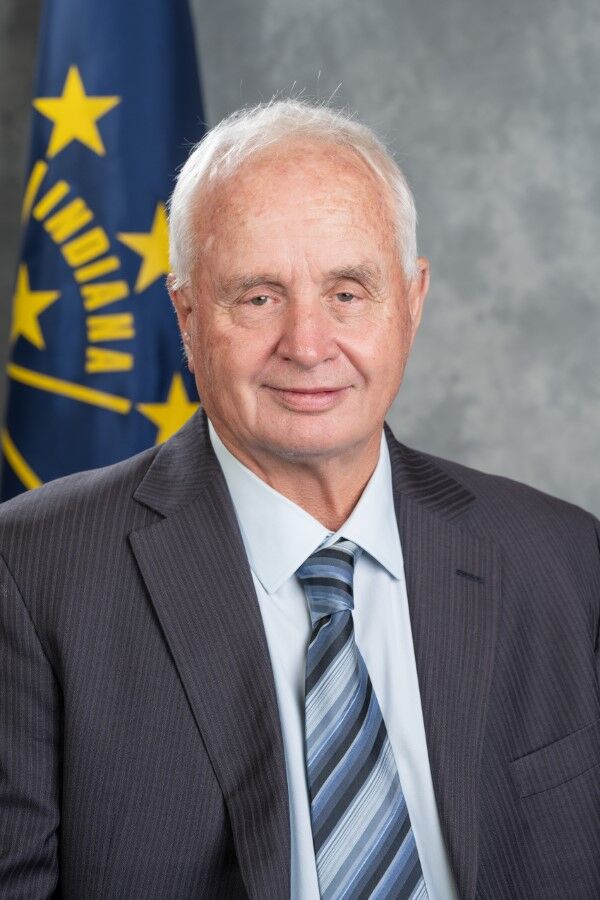

Sen. Rick Niemeyer, R-Lowell.
Sen. Rick Niemeyer, R-Lowell, is the chair of the Senate Committee on Environmental Affairs. He has served as chair of the Lake County Solid Waste Board and been a member of the Lake County Drainage Board Advisory Committee. He attended Indiana State University.
Niemeyer is also the owner of Lowell Livestock Auction and Niemeyer Auction Service.
He authored an environmental matters bill—Senate Bill 459—which allows the Environmental Rules Board to establish rules/requirements for the reuse of treated wastewater and requires tighter cybersecurity management within these facilities. It passed its third reading in the Senate on Tuesday.
Senate Bill 102 would put some restriction on carbon sequestration. It would require county approval of the storage site in instances where carbon dioxide is taken outside of that county. Senate Bill 504 is similar, requiring a risk assessment and carbon dioxide injection estimate to be included in an application for a carbon dioxide transmission pipeline. Both bills are sitting in the Senate Utilities Committee.
Currently on its second reading, Senate Bill 103, also authored by Niemeyer, would task the Indiana Department of Environmental Management with conducting a study on vehicles owned by residents 65 years or older, which could then be exempt from motor vehicle emissions testing while retaining federal air quality standards.
Rep. Shane Lindauer, R-Jasper


Rep. Shane Lindauer, R-Jasper.
With a bachelor of science in industrial supervision technology, Rep. Shane Lindauer, R-Jasper, is the standing chair of the House Committee on Natural Resources and the House Committee for Roads and Transportation. He was a co-owner of Jasper Salvage from 2007 to January 2020.
Early in the 2025 session, Lindauer authored House Bill 1616. It would set a maximum $10,000 tax credit for residents responsible for the preservation of a historic property and create guidelines for the Department of Natural Resources in establishing submerged lands preserves. It passed the House Natural Resources Committee on Jan. 27.
He’s also House sponsor of Senate Bill 280, which would allow rifle hunting of white-tailed deer on public property in the hunting season following June 30, 2025. It passed the Senate Feb. 4.
Rep. Edmond Soliday, R-Valparaiso
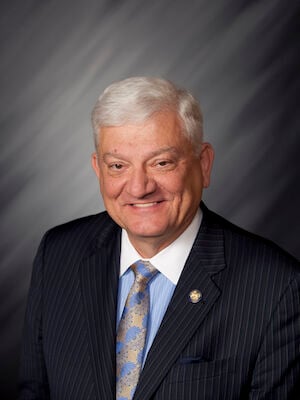
Rep. Edmond Soliday, R-Valparaiso.
Rep. Edmond Soliday, R-Valparaiso, is the standing chair of the House Utilities, Energy and Telecommunications Committee.
Carbon sequestration is yet again a topic. Soliday authored House Bill 1579, which amends eminent domain to include carbon dioxide transmission pipelines and constructs a variety of other related legislation. It’s currently on its second House reading.
House Bill 1007 concerns small modular nuclear reactors, establishing energy generation resources and, as stated in the legislature, “provides a credit against state tax liability for expenses incurred in the manufacture of a small modular nuclear reactor in Indiana.” It is currently awaiting its third reading.
Editor’s note: This headline was rewritten Feb. 14 to more clearly reflect the content of the article.
link



More Stories
12-hour days, no weekends: the anxiety driving AI’s brutal work culture is a warning for all of us | AI (artificial intelligence)
How would Maine’s proposed climate superfund work?
Tesla Fosters Toxic Work Environment at German Plant, Union Says