

Historically and today, success requires a healthy work life or (QWL). Marx’s alienation, Herzberg’s two-factor, Kalleberg’s job satisfaction, Taylor’s scientific management, Fayol’s general management, and Elton Mayo’s ideas suggest that QWL affects industry performance [23, 24, 27, 28, 80]. Taylor is quantitative, and Mayo is environmental and personal, but both value individuals [10]. Marx identified three categories of job injustice-related worker alienation [82, 89, 90]. This scholar said intrinsic and extrinsic job qualities boost QWL and performance. Understanding why job dissatisfaction affects industrial labour force’ QWL is crucial. McClelland and Alderfer’s multiplier effect, Maslow’s needs theory, and Herzberg’s two-factor theory encourage QWL. These views indicate that basic wants can affect family and personal life [29, 77]. QWL evaluates work conditions, advancement, recognition, involvement, workload, employment security, community engagement, and work-life balance. Kurt Lewin’s Field Theory of Employee Behavior ties performance to QWL [73, 56], proposing that organizational rewards, job nature, and citizen and client connections may affect QWL. Kalleberg’s job characteristics and incentive system theory impact QWL with six job satisfaction parameters [82, 90]. Life depends on work. Job experiences and QWL impact organizational performance and job and non-work satisfaction. To define its components, QWL has been researched from many angles [12, 32].
Employees’ QWL can be comprehended by applying Marx’s theory of alienation and Herzberg’s two-factor theory. Marx’s theory demonstrates that workplace disparities lead to alienation by emphasizing work’s inherent and external characteristics that create a division between individuals and their true selves [47, 82, 89]. Herzberg’s theory highlights the significance of hygiene factors, such as wages and working conditions, and motivators, such as recognition and opportunities for growth, about job satisfaction and QWL. Because it improves employee well-being and organizational outcomes, QWL research is rising. Late 1960s-founded QWL connects workers and employers (10]; Gowrie et al., 2015; [63]). Davis discussed “quality of work life” and behavioral science at the American Assembly on the Changing World of Work. Later, Job Characteristics models covered psychosomatic development and QWL [47, 82, 89]. This literature review combines disconnected theoretical expositions. Hypotheses from theories and job characteristics models inform the conceptual framework. Shrestha et al. [80] and Meha and Chernovita [60] found that business culture, training, and job stability strongly influence QWL opinions and performance. Review studies for patterns, disagreements, and gaps. Rogers et al. [77] found that women favored QWL over men, suggesting gender differences [33]. Melnick and Osano [61] valued job security and engagement over gender equality. These findings suggest gender-specific QWL research and groups. Yashak et al. [90] and Huda [41] discovered income, benefits, social integration, and esteem demands due to QWL complexity. This synthesis emphasizes financial and non-financial QWL measurement and intervention for employee well-being and company performance. The evaluation favors QWL, although viewpoint, complexity, and restrictions must be considered. Organizational policies and leadership styles strongly affect employee experiences and QWL, according to Hossain et al. [40] and Kumar [53], Gazi et al. [23, 28] highlighted QWL’s effects on work satisfaction, organizational performance, and implementation. QWL dynamics and contextual efficacy research benefit from distinct perspectives. Critically assessing multiple viewpoints helps firms adjust to QWL’s potential and challenges. Finally, this literature review builds QWL’s conceptual framework by synthesizing essential ideas, integrating study findings, and considering alternative perspectives. We strengthen QWL dynamics research and organizational practice by addressing this study.
The QWL concept has progressed from its origins in early management theories to incorporate a more human-centric approach. Although historical viewpoints such as job satisfaction and workplace autonomy hold significance, modern research highlights the role of corporate culture, growth opportunities, and recognition in enhancing employee well-being in different industries. By synthesizing various theories and conducting a rigorous analysis of current research, the researcher may cultivate a more comprehensive comprehension of QWL and its effects on people and companies.
Factors affecting QWL and research hypotheses
Much research has explored QWL, covering work and non-job factors—some research QWL’s effects on customer satisfaction, others productivity [23]. QWL includes psychosocial factors, health, workplace well-being, and working resources and infrastructure [24, 48]. Improved workspaces, democratic management, and job satisfaction are included. Our study identified nine key components: work environment, organizational culture, relationships and cooperation, training and development, compensation and rewards, facilities, job satisfaction and security, work autonomy, and adequate [5, 7, 39, 57, 65, 74], .
Work Environment (WE) and QWL
A pleasant working environment is critical to improving employee QWL and organizational performance [37]. QWL drives employee motivation, performance, and satisfaction. Vaidya and Lumba (2021) showed that workplaces affect industrial labour force’ QWL. They found that role stress, job features, supervisory methods, structural aspects, and ethical concerns directly and indirectly affect industrial experiences, attitudes, and behavior. Dobbins et al. [15] found that plant size, workload, social and demographic variables, industrial relations, and economic conditions affect factory workers’ QWL, supporting the importance of the workplace environment. Moro et al. [63] and Majumder and Biswas [57] also stressed the need for fair working hours and a safe physical and mental workplace for QWL. Shrestha et al. [80] showed that the work environment, particularly the physical environment and social integration, affects QWL [49]. The results stressed the necessity of suitable work conditions for QWL. Gazi et al. [26] presented a nuanced viewpoint by showing a favorable association between workplace spirituality and QWL, demonstrating the complexity of QWL-enhancing variables. The physical workspace, encompassing elements like lighting, air quality, noise levels, and ergonomic furniture, is pivotal in employee comfort and productivity [89]. A well-designed environment prioritizing these factors can significantly enhance job satisfaction and overall QWL [5, 70]. Likewise, the social environment within the workplace, including interactions with colleagues and supervisors, profoundly impacts employees’ experiences. Supportive relationships, effective communication, and a culture of respect and collaboration foster a sense of belonging and camaraderie, positively influencing QWL (Vaidya & Lumba, [87]; Rogers et al. [77]). Based on the literature, this study’s hypotheses…
Organizational Culture and Climate (OCC), and QWL
Employees’ work environment and quality of life are shaped by organizational culture and climate (OCC) via common ideas, beliefs, and practices (Kotter et al., [51]; Leitão et al., [54]). According to Moro et al. [63], organizational culture (OCC) significantly correlates with QWL, with each facet of OCC exhibiting a significant link [51, 55]. The Denison cultural framework states that a solid organizational culture includes high involvement, consistency [59], flexibility, and a defined goal [79], offering OCC-focused organizations a competitive edge and boosting QWL, especially among industrial labour force. Majumder and Biswas [57] say authority, position, job, and person impact QWL in organizational culture. Gazi et al. [26] found that organizational culture and surroundings promote QWL. QWL emphasizes organizational climate—the collective conduct of workers who share beliefs, norms, and other well-being characteristics [51, 55]. When there is coherence between personal and organizational values, employees feel a greater sense of purpose and fulfillment in their work, contributing positively to their QWL [29]. A positive organizational culture marked by support, respect, and trust creates an environment where staff members feel valued and appreciated [54]. Employees are likelier to report higher work satisfaction and total QWL when they believe their company is concerned about their welfare [78]. Moro et al. [63] observed a strong 0.759 correlation between organizational climate and QWL. Literature suggests the following hypothesis:
Relation and Cooperation (RC), and QWL
A recent study shows that workplace interactions and teamwork boost QWL [61]. Saidykhan and Ceesay [78] found a strong correlation between management interaction and cooperation and hospital workers’ QWL dimensions. QWL increases employee cooperation, collaborations, and interactions across sectors, according to Nuangjamnong [65] and Saidykhan and Ceesay [78]. Human connections, especially supportive management-employee links and teamwork, considerably impact QWL, according to Moro et al. [63] and Saidykhan and Ceesay [78]. Research indicates that positive relationships with colleagues and supervisors create a supportive work environment where employees feel valued, respected, and understood. This social support network enhances psychological well-being, reduces stress, and contributes to overall job satisfaction and QWL [61]. Additionally, when employees feel supported by their colleagues and supervisors, they may be more willing to seek help or accommodations to manage personal and professional responsibilities. This balance contributes to overall well-being and QWL [7, 86]. Based on these findings, this research hypothesizes:
Training and Development (TD), and QWL
Training may improve organizational and individual performance [14]. A thorough corporate training and development program may increase QWL across all hierarchies. Organizational performance and work-life balance are the goals of this approach [40]. Training fosters positive and constructive development related to organizational objectives, enhancing employee work-life quality, according to Simes and Tichenor [82]. According to research, training improves worker capabilities and when employees feel competent and capable in their job tasks, they experience greater job satisfaction and confidence, leading to an improved QWL [14]. Continuous learning and development help people adjust to role, industry, and technology changes. When individuals can handle obstacles and seize new possibilities, they have less stress and more job satisfaction, improving QWL [38, 72]. Majumder and Biswas [57] prioritize staff training and development to improve QWL in employee engagement and retention [29]. Engaged employees are more likely to be motivated, productive, and satisfied with their work, leading to a higher QWL overall [38]. Literature suggests that training and development affect QWL.
Compensation and Rewards (CR), and QWL
Rewords and compensation motivate workers to achieve personal and organizational objectives [35]. A high QWL requires safety, fair remuneration, equitable employment chances, and professional advancement [52]. Job satisfaction, hours, and incentives impact QWL found Sahni et al., [79]. Javanmardnejad et al. [45] concurs that fair compensation, salary, working hours, employment opportunities, and growth and reward opportunities affect job satisfaction and QWL [79]. An excellent work-life requires safety, fair compensation, recognition, and incentives for outstanding performance (Wang et al. [89]). Wage gaps may reduce job satisfaction and QWL [9]. Worker happiness and comfort enhance QWL with stable employment and fair remuneration [9]. Ahn et al. [1] highlights social norms and fair pay for QWL improvement. According to the study, recognition, prizes, and compensation strongly affect employee satisfaction and QWL.
This study proposes the following hypothesis from the literature:
Facilities (FA) and QWL
Employee QWL may be improved by fulfilling physical and emotional needs. QWL facilities help organizations achieve objectives [44]. The accommodations include food, housing, transportation, allowances, and more [39]. In banking, Gazi et al. [26] discovered that QWL is essential to organizational effectiveness [41]. Moro et al. [63] underlined the relevance of facilities in employee satisfaction and the necessity for proper amenities to boost QWL and retain a competent workforce. Dobbins et al. [15] observed that poor workplace amenities impair workers’ productivity and quality of life [79]. Numerous studies suggest that appropriate and appealing workplace facilities boost worker quality of life and organizational productivity. Facilities that provide amenities such as cafeterias, fitness centres, childcare facilities, or relaxation areas contribute to employees’ well-being by offering opportunities for relaxation, socialization, and personal development ([9]). Access to these amenities can improve morale and job satisfaction, enhancing QWL [44]. Thus, good facilities boost QWL and organizational success.
Based on these facts, this study presents this hypothesis:
Autonomy at Work (AW) and QWL
Worker autonomy encompasses pace, job sequencing, assignment control, and when and where to work [71]. The JCM argues work autonomy impacts motivation, performance, commitment, and job satisfaction (Khavis & Krishnan, 2020). Job design affects work autonomy, say researchers. Amin et al. [2] emphasized QWL management and goal-setting for job autonomy. Job autonomy allows employees make decisions and accomplish goals ([26, 41]). Duarte et al. [17] revealed that job autonomy and an innovative culture predict QWL across employee categories, with supervisors having a lower QWL than workers. Jain and Qureshi [44] argue that job autonomy may boost QWL and organizational performance. Jain and Qureshi [44] also showed a strong positive link between QWL and workplace autonomy, showing how organizational structures affect employee decision-making. Money and autonomy were the most significant factors affecting nurses’ QWL, according to Duarte et al. [17], underscoring the significance of work autonomy. Job enrichment, workplace autonomy, and involvement boost employee satisfaction and productivity, according to Wang et al. [89]. Jain, Q. [44]. Ruhana [76] and Amin et al. [2] revealed a favourable association between QWL and work autonomy, validating Meha and Chernovita. The literature-based analysis hypothesizes…
Adequacy of Resources (AR) and QWL
Workplace resources influence employee satisfaction and quality of life, which impacts goal achievement ([65]. Tasks need time, tools, and expertise to help enhance work-life quality [67, 91]. However, more resources diminish worker productivity, resulting in missed deadlines and higher job satisfaction. Research shows that resources impact job satisfaction and work-life balance [74]. Inadequate resources can lead to a detrimental work atmosphere marked by frustration, inefficiency, and discontentment. In contrast, when resources are sufficient, it cultivates a favourable work atmosphere where employees perceive themselves as being assisted and appreciated, resulting in elevated job contentment and overall work-life excellence ([65]. Gazi et al. [26] and Hossain et al. [40] assessed faculty members’ work-life quality using a modified Walton questionnaire, including remuneration, working conditions, career prospects, security, and resource sufficiency. They found that resource sufficiency and relevancy were significantly correlated with work-life quality and satisfaction.
Based on these facts, this study suggests:
Job Satisfaction and security (JS), and QWL
High QWL boosts employee happiness [44]. Moro et al. [63] showed that organizational policies boost hospital staff’s job satisfaction and quality of life. Majumder and Biswas [57] showed a substantial correlation between QWL and work satisfaction. Moro et al. [63] studied faculty QWL using community connection, faculty relationships, pay, department chairpersons, campus services, and demographic characteristics. Work satisfaction was a critical effect. For Andrade et al. [4], happy workers are more productive, provide better customer service, and have a better work life. QWL is associated with job happiness and security [6, 66]. Research shows that QWL programs boost employee job satisfaction. According to Li et al. [56], job assessment causes a positive emotional state known as work satisfaction. Happier people engage more, enhancing their professional lives [44]. QWL requires employment security, according to workers [65]. Permanent employment boosts stability, and QWL—employment stability and pay impact workers’ well-being [19]. Employees abhor management prejudice and job uncertainty. Thus, constant employment boosts QWL ( Nanjundeswaraswamy
& Swamy, [64]; Nuangjamnong, [65]).
Research hypothesizes from these findings…
Therefore, based on the previous research, we may evaluate the significance of quality of life for industrial employees in Bangladesh. The primary goal in this study is to fill the existing gap in QWL research in the context of Bangladesh (Fig. 1). Many studies have been done on QWL for people in different jobs, but not many on those working in Bangladesh’s industrial sector. This study advances QWL research and fills a gap in the field. As a labor-intensive country, workers’ quality of life at work has become a major concern for all local industrial sectors. Bangladesh is a growing South Asian nation with several labor-intensive industries as well as many capital-intensive ones. Quality of life at work is essential for the large number of Bangladeshi workers in diverse industries. In this case, we identified a research gap on the topic and chose to investigate the QWL of industrial labour force in Bangladesh and the factors affecting QWL consequences.
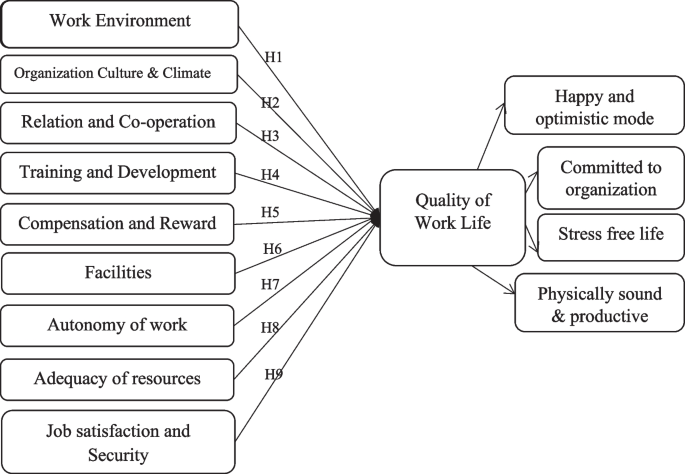
Proposed conceptual research model
link




More Stories
12-hour days, no weekends: the anxiety driving AI’s brutal work culture is a warning for all of us | AI (artificial intelligence)
How would Maine’s proposed climate superfund work?
Tesla Fosters Toxic Work Environment at German Plant, Union Says