
Passenger Car Hub Bearings Market Forecast Outlook 2026 to 2036
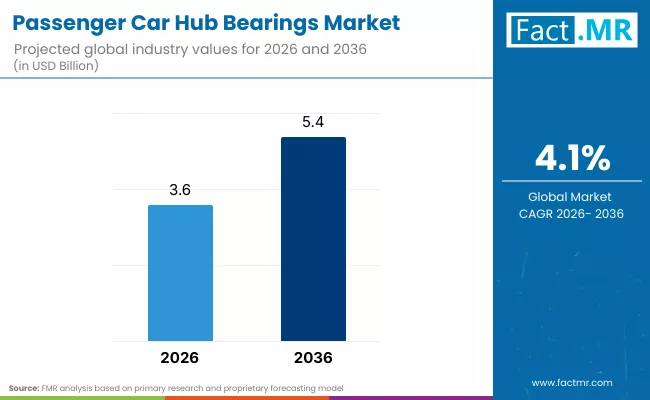
The passenger car hub bearings market is estimated at USD 3.6 billion in 2026 and is projected to reach USD 5.4 billion by 2036, expanding at a 4.1% compound annual growth rate (CAGR).
Key Takeaways from Passenger Car Hub Bearings Market
- Passenger Car Hub Bearings Market Value (2026): USD 3.6 billion
- Passenger Car Hub Bearings Market Forecast Value (2036): USD 5.4 billion
- Passenger Car Hub Bearings Market Forecast CAGR (2026-2036): 4.1%
- Leading Segment in Passenger Car Hub Bearings Market: Standard Steel Hub Bearings (67%)
- Key Growth Region in Passenger Car Hub Bearings Market: Asia Pacific
- Key Players in Passenger Car Hub Bearings Market: SKF AB, Schaeffler AG, NSK Ltd., NTN Corporation, JTEKT Corporation, Timken Company, ILJIN Group Co., Ltd., GMB Corporation, C&U Group Co., Ltd., ZWZ (Wafangdian Bearing Group Co., Ltd.)
Highlighting the fundamental role of wheel-end integrity, Rickard Gustafson, President and CEO of SKF, noted in early 2026: “In a tough market environment, it’s encouraging that we continue to win several strategically important margin accretive contracts… boding well for the future.”
Positioned as the critical link between the drivetrain and the road, hub bearings serve as a primary indicator of a vehicle’s mechanical efficiency and safety profile. The space exerts significant competitive weight through high barriers to entry, driven by the precision engineering required to manage the unique torque loads of electric mobility. As OEMs consolidate around global platforms, these components have transitioned from simple rotating parts to sophisticated “Gen 3” units that define vehicle handling and lifecycle reliability. Consequently, the market acts as a strategic floor for Tier 1 suppliers, where technological mastery over friction and noise directly dictates long-term contract security.
Passenger Car Hub Bearings Market
| Metric | Value |
|---|---|
| Estimated Value in (2026E) | USD 3.6 billion |
| Forecast Value in (2036F) | USD 5.4 billion |
| Forecast CAGR (2026 to 2036) | 4.1% |
Category
| Category | Sub-Segment |
|---|---|
| By Hub Bearing Generation | Gen 1-2 Bearings; Gen 3 Hub Units; Gen 4 Hub Units; Gen 5 / Lightweight Hub Units |
| By Powertrain Type | ICE Vehicles; HEV/PHEV; BEV; Other |
| By Sales Channel | OEM / Line-Fit; Aftermarket Replacement; Other |
| By Design & Materials | Standard Steel Hub Bearings; Corrosion-Resistant Coatings; Lightweight/Optimized Designs; Other |
| Region | North America; Europe; Asia Pacific; Latin America; Middle East & Africa |
Segmental Analysis
What is Driving the Dominance of Standard Steel Hub Bearings in the Passenger Car Hub Bearings Market?
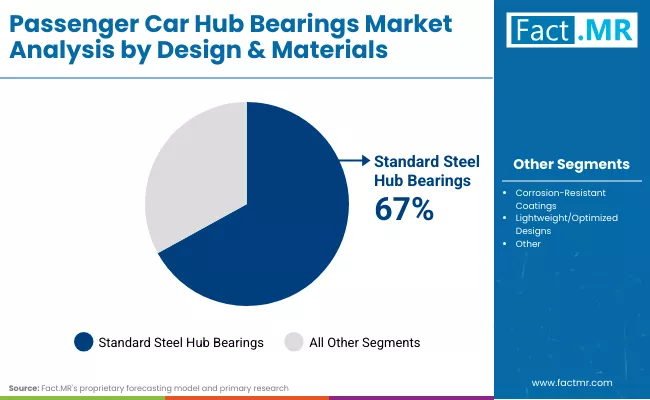
Standard Steel Hub Bearings hold 67% of the market share in 2026. These bearings are favored for their durability, cost-effectiveness, and performance in handling the high loads and stresses typically seen in passenger vehicles. Steel hub bearings are widely used in a variety of vehicle types, offering superior strength and resistance to wear and tear, making them the preferred choice for mass-market vehicles.
What is the Role of ICE Vehicles in the Passenger Car Hub Bearings Market?
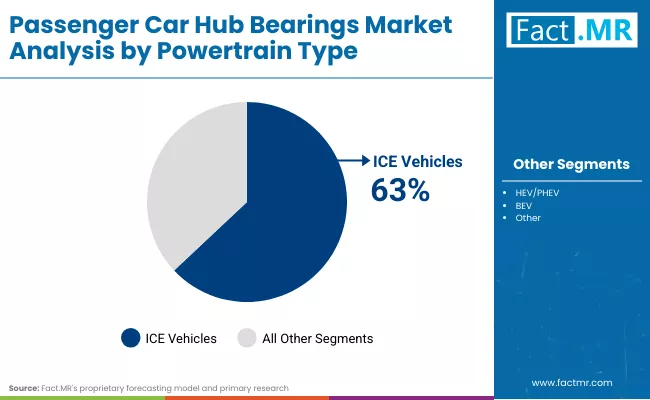
ICE Vehicles (Internal Combustion Engine vehicles) account for 63% of the market share in 2026. The continued dominance of ICE vehicles in the global passenger car market directly impacts the demand for hub bearings. These vehicles require robust and reliable hub bearings for optimal wheel and axle performance. While the share of electric vehicles (EVs) is growing, ICE vehicles remain the dominant powertrain type, driving steady demand for standard steel hub bearings in the market.
What are the Drivers, Restraints, and Key Trends in the Passenger Car Hub Bearings Market?
Demand for passenger car hub bearings is shaped by requirements for reliable wheel support, smooth rotation, and load transfer across sedans, SUVs, and light trucks. OEMs and tier‑1 suppliers specify hub bearing assemblies that deliver low friction, high durability, and compatibility with ABS, traction control, and EV drivetrain systems. Procurement teams prioritize suppliers that can meet tight dimensional tolerances, consistent preload characteristics, and quality standards that support high‑volume assembly lines. Growth in electrified and autonomous vehicle platforms influences sourcing strategies and technical specifications as NVH and thermal performance become more critical. Higher material and manufacturing costs constrain uptake in entry‑level segments with stringent cost targets, and variability in road conditions across regions affects service life expectations. Key trends include development of integrated sensor‑equipped bearing units that support vehicle stability systems and expansion of sealed, low‑maintenance designs that improve longevity while reducing lifecycle service requirements.
Analysis of the Passenger Car Hub Bearings Market by Key Country
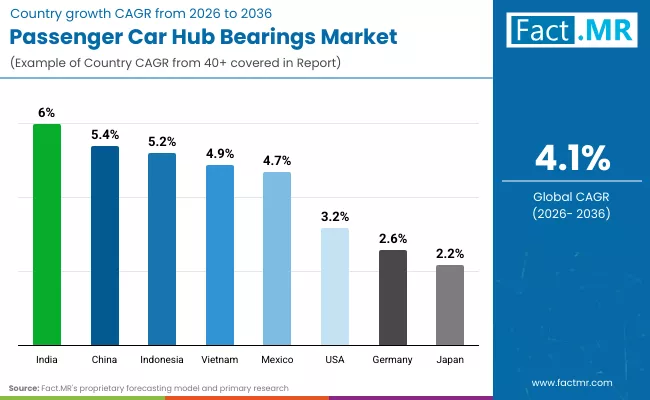
| Country | CAGR (Forecast Period) |
|---|---|
| India | 6.0% |
| China | 5.4% |
| Indonesia | 5.2% |
| Mexico | 4.7% |
| Vietnam | 4.9% |
| USA | 3.2% |
| Germany | 2.6% |
| Japan | 2.2% |
What Factors Drive the 6.0% Growth in the India Passenger Car Hub Bearings Market?
India’s 6.0% growth in the passenger car hub bearings market is primarily driven by the rapid expansion of the automotive industry, particularly the growing demand for passenger cars and SUVs. The premiumization of the Indian car market and increased urbanization have led to a rise in vehicle ownership, contributing to the demand for high-quality hub bearings. The government’s Production Linked Incentive (PLI) Scheme has also boosted local manufacturing of automotive components, helping meet domestic demand while also catering to export markets. The increasing adoption of advanced technologies in vehicles, such as ABS and ESC, has further supported growth in the hub bearings market.
Why is the China Passenger Car Hub Bearings Market Projected to Expand at 5.4%?
China’s 5.4% expansion in the passenger car hub bearings market can be attributed to the country’s dominance in automotive production and sales, with a strong focus on New Energy Vehicles (NEVs). As the largest automotive market in the world, China’s shift toward electric and hybrid vehicles is driving the demand for advanced and durable hub bearings that can handle the unique challenges of these new powertrains. Furthermore, government initiatives to promote local production and sustainability in the automotive sector are contributing to the growth of the hub bearings market, as vehicle manufacturers increasingly demand high-quality, cost-effective components.
How Does the 5.2% Growth Reflect the Indonesia Passenger Car Hub Bearings Market Expansion?
Indonesia’s 5.2% growth is driven by increased vehicle production in the country, particularly in the passenger car and light commercial vehicle segments. As the automotive market in Indonesia expands, there is a rising demand for more durable and reliable automotive components like hub bearings. The expansion of infrastructure and automotive manufacturing facilities, driven by foreign direct investment and government initiatives, is expected to further increase production volumes of automotive components, including hub bearings, in the coming years. Rising disposable incomes and growing urban populations are further supporting the demand for personal vehicles, fueling market expansion.
What Drives the 4.7% Growth in the Mexico Passenger Car Hub Bearings Market?
Mexico’s 4.7% growth in the passenger car hub bearings market is influenced by the country’s strategic position as a manufacturing hub for the North American automotive industry, particularly for OEMs. The USMCA trade agreement has facilitated closer integration with the U.S. and Canadian automotive markets, increasing demand for locally produced components, including hub bearings. Mexico’s strong automotive manufacturing base, along with the growing shift towards electric vehicles (EVs), is leading to a rise in the need for high-quality hub bearings. The country’s nearshoring trend, particularly in the automotive industry, is also contributing to the growth.
Why is the Vietnam Passenger Car Hub Bearings Market Projected to Expand at 4.9%?
Vietnam’s 4.9% growth in the passenger car hub bearings market is attributed to its growing automotive sector, driven by increased domestic demand and the country’s strategic position as a key manufacturing base in Southeast Asia. As Vietnam’s economy develops and consumer purchasing power increases, more people are purchasing passenger cars, which in turn boosts the demand for automotive components like hub bearings. Additionally, the expansion of automotive exports and the government’s focus on automotive manufacturing and infrastructure development are propelling the demand for high-quality, cost-effective hub bearings.
What Drives the 3.2% Growth in the USA Passenger Car Hub Bearings Market?
The 3.2% growth in the USA passenger car hub bearings market is driven by the ongoing demand for passenger cars, particularly SUVs and trucks. The automotive industry’s focus on quality and innovation in safety features such as anti-lock braking systems (ABS) and electronic stability control (ESC) is increasing the adoption of high-performance hub bearings. Additionally, aftermarket demand remains strong, as the aging fleet of vehicles in the U.S. drives the need for replacement parts, including hub bearings. The shift toward electric vehicles (EVs) is also contributing to market growth, as EVs require hub bearings designed for higher torque loads.
Why is the 2.6% Growth in the Germany Passenger Car Hub Bearings Market Significant?
Germany’s 2.6% growth in the passenger car hub bearings market is mainly driven by the country’s automotive industry, particularly the luxury vehicle segment. German manufacturers are known for their high-performance vehicles, which require durable and high-quality hub bearings. Additionally, Germany’s leadership in the electric vehicle market is driving the development and adoption of specialized hub bearings that can withstand the unique challenges of EVs, such as higher torque and battery weight. The country’s focus on sustainability and technological advancements in automotive manufacturing continue to fuel the demand for innovative automotive components like hub bearings.
Why Does Japan Exhibit a 2.2% Growth in the Passenger Car Hub Bearings Market?
Japan’s 2.2% growth in the passenger car hub bearings market is influenced by the country’s strong automotive manufacturing base, particularly in the high-performance and hybrid vehicle segments. Japan’s automotive industry is increasingly focusing on electric and hybrid vehicles, which require hub bearings designed for higher performance and durability. The shift toward compact and fuel-efficient vehicles is driving demand for specialized hub bearings that can reduce weight and improve vehicle efficiency. Japan’s ongoing investment in sustainable automotive technologies and infrastructure development further supports growth in the hub bearings market.
How Are Key Players Competing in the Passenger Car Hub Bearings Market?
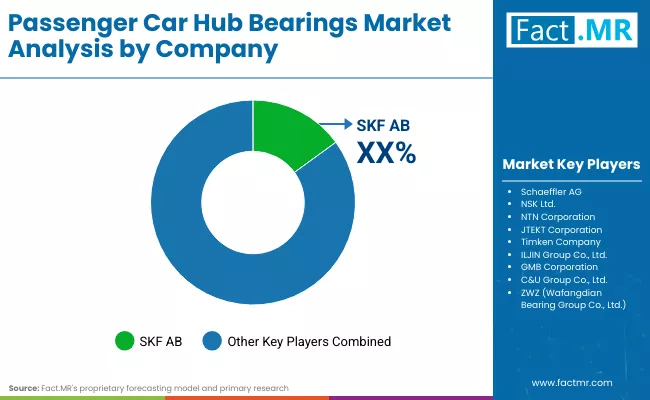
The passenger car hub bearings market is shaped by competition around durability, low friction performance, and integration with electrified platforms. SKF, Schaeffler, and NSK emphasize advanced sealing, optimized grease formulations, and sensor-ready hub units to support ABS and ESC systems. NTN and JTEKT focus on high-precision manufacturing to improve noise behavior and bearing life in compact and mid-size vehicles. Timken leverages metallurgical expertise to deliver robust solutions for higher load requirements. Asian suppliers such as ILJIN, GMB, C&U Group, and ZWZ compete through cost-efficient, high-volume production, supporting mass-market passenger cars. Differentiation increasingly depends on NVH reduction, weight optimization, and compatibility with electric and hybrid drivetrains, mirroring supplier innovation patterns in the automotive lightweight materials market.
Recent Industry Developments
- Patent – Wheel Hub Bearing with Integrated ABS Sensor (Published Feb 15, 2023): A patented wheel hub bearing assembly with an integrated ABS speed sensor and improved sealing arrangement was published, showing ongoing innovation in hub bearing design for passenger cars.
- Patent – Dampened Hub Bearing for NVH Reduction (Published Nov 7, 2024): A patent application for a dampened wheel hub bearing assembly with internal damping elements that reduce noise, vibration, and harshness (NVH) was published, reflecting advancements aimed at improving ride quality in modern passenger cars.
- Product Technology / Supplier Launch (2025): SKF introduced its next-generation passenger car wheel hub bearing series featuring optimized sealing and corrosion-resistant materials designed for extended life and EV compatibility, with official product details released by the company.
Key Players of the Passenger Car Hub Bearings Market
- SKF AB
- Schaeffler AG
- NSK Ltd.
- NTN Corporation
- JTEKT Corporation
- Timken Company
- ILJIN Group Co., Ltd.
- GMB Corporation
- C&U Group Co., Ltd.
- ZWZ (Wafangdian Bearing Group Co., Ltd.)
Scope of the Report
| Items | Values |
|---|---|
| Quantitative Units (2026) | USD Billion |
| By Hub Bearing Generation | Gen 1-2 Bearings, Gen 3 Hub Units, Gen 4 Hub Units, Gen 5 / Lightweight Hub Units |
| By Powertrain Type | ICE Vehicles, HEV/PHEV, BEV, Other |
| By Sales Channel | OEM / Line-Fit, Aftermarket Replacement, Other |
| By Design & Materials | Standard Steel Hub Bearings, Corrosion-Resistant Coatings, Lightweight/Optimized Designs, Other |
| Regions Covered | North America, Europe, Asia Pacific, Latin America, Middle East & Africa |
| Countries Covered | United States, Canada, Mexico, Germany, United Kingdom, France, Japan, South Korea, China, India, Brazil, and other countries |
| Key Companies Profiled | SKF AB, Schaeffler AG, NSK Ltd., NTN Corporation, JTEKT Corporation, Timken Company, ILJIN Group Co., Ltd., GMB Corporation, C&U Group Co., Ltd., ZWZ (Wafangdian Bearing Group Co., Ltd.) |
| Additional Attributes | Dollar revenue by hub bearing generation, powertrain type, sales channel, design & materials, and region; regional demand trends, competitive landscape, technological advancements in passenger car hub bearings, operational performance optimization initiatives, and product development strategies |
Passenger Car Hub Bearings Market Key Segments
-
By Hub Bearing Generation :
- Gen 1-2 Bearings
- Gen 3 Hub Units
- Gen 4 Hub Units
- Gen 5 / Lightweight Hub Units
-
By Powertrain Type :
- ICE Vehicles
- HEV/PHEV
- BEV
- Other
-
By Sales Channel :
- OEM / Line-Fit
- Aftermarket Replacement
- Other
-
By Design & Materials :
- Standard Steel Hub Bearings
- Corrosion-Resistant Coatings
- Lightweight/Optimized Designs
- Other
-
Region :
- North America
- Europe
- Germany
- UK
- France
- Italy
- Spain
- Nordic Countries
- BENELUX
- Rest of Europe
- Asia Pacific
- China
- Japan
- South Korea
- India
- Australia
- Rest of Asia Pacific
- Latin America
- Brazil
- Argentina
- Rest of Latin America
- Middle East and Africa
- Kingdom of Saudi Arabia
- United Arab Emirates
- South Africa
- Rest of Middle East and Africa
- Other Regions
- Oceania
- Central Asia
- Other Markets
- North America
Bibliographies
- Society of Automotive Engineers (SAE). (2023). Integration of wheel speed sensors within hub bearing assemblies for ABS and ESC systems. SAE Technical Paper Series.
- International Organization for Standardization. (2023). ISO 15243: Rolling bearings – Damage and failures – Terms, characteristics and causes. ISO.
- United Nations Economic Commission for Europe (UNECE). (2024). UN Regulation No. 13-H – Braking and wheel-end performance requirements for passenger vehicles. UNECE.
- National Highway Traffic Safety Administration (NHTSA). (2023). Wheel-end integrity and braking system interaction in passenger vehicles. U.S. Department of Transportation.
- Institute of Electrical and Electronics Engineers (IEEE). (2024). Sensor-integrated hub bearing units for vehicle stability control systems. IEEE Xplore Digital Library.
link




More Stories
Voltage Regulators Market Analysis: End-Use Segments & Revenue Forecast
$9.71 Bn Electric Two Wheeler Market Analysis by Vehicle, Voltage Type, Motor Type, Battery, Motor Power, Technology, Vehicle Class, Usage, Region
Grain Alcohol Market Analysis: Segmentation, Major Trends,