
Tissue Protectors Market Forecast and Outlook 2026 to 2036
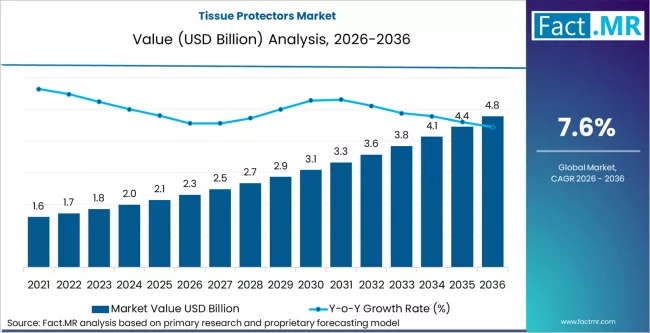
The tissue protectors market records USD 2.3 billion in 2026 and advances to USD 4.8 billion by 2036 at a 7.6% CAGR.
Tissue Protectors Market Key Takeaways
- Tissue Protectors Market Value (2026): USD 2.3 billion
- Tissue Protectors Market Forecast Value (2036): USD 4.8 billion
- Tissue Protectors Market Forecast CAGR 2026 to 2036: 7.6%
- Leading Product Type in Tissue Protectors Market: Wound edge protectors or retractors
- Key Growth Regions in Tissue Protectors Market: Asia Pacific, Europe, North America, Latin America, Middle East & Africa
- Top Players in Tissue Protectors Market: Applied Medical, Medtronic, Becton Dickinson, Cardinal Health, Mölnlycke
The expansion path shows a steady rise through earlier levels at USD 1.6 billion, USD 1.8 billion, USD 2.0 billion, USD 2.1 billion, and USD 2.5 billion before the current scale was established. This category functions as a routine safeguard within surgical and interventional procedures rather than as a discretionary add-on.
Selection criteria emphasize dimensional accuracy, material stability, and predictable barrier performance during prolonged use. Once a specific format is approved within a procedure set, it remains in place due to protocol alignment, staff training, and inventory standardization. Consumption follows procedure volumes and case mix rather than changes in product design. Volume growth reflects wider adoption across departments and higher intervention counts, not frequent specification changes or rapid product turnover.
Tissue Protectors Market
| Metric | Value |
|---|---|
| Market Value (2026) | USD 2.3 billion |
| Forecast Value (2036) | USD 4.8 billion |
| Forecast CAGR 2026 to 2036 | 7.6% |
Category
| Category | Segments |
|---|---|
| Product Type | Wound edge protectors or retractors; Organ or tissue protection pads and sheets; Laparoscopic trocar site protectors; Nerve and tendon protectors; Barrier drapes and localized shields; Other tissue protection accessories |
| Application or Surgical Area | Abdominal and general surgery; Minimally invasive surgery (MIS); Orthopedic surgery; Cardiovascular and thoracic surgery; OB or GYN surgery; Other surgical specialties |
| End User or Sales Channel | Hospitals; ASCs; Specialty surgical centers; Distributor channels; GPO or tender procurement |
| Region | North America; Europe; Asia Pacific; Latin America; Middle East & Africa |
Segmental Analysis
Why Do Wound Edge Protectors and Retractors Set the Baseline for Tissue Protection Planning?
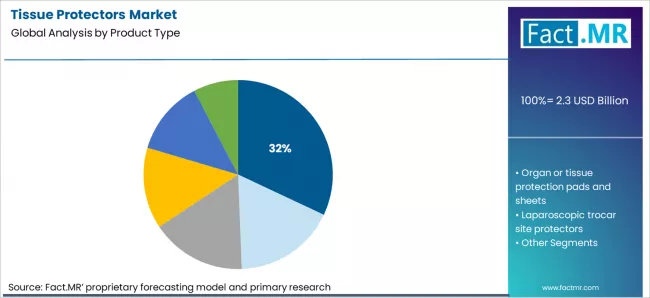
Case setup in the tissue protectors market frequently starts with wound edge protectors or retractors, which hold a 32.00% share by product type. These devices sit directly at the incision site, where exposure, contamination risk, and tissue stress meet. Surgeons and scrub teams treat them as standard components in open procedures that involve repeated instrument passage. Storage and sterilization workflows already account for this category, which keeps availability high across operating rooms. Training steps remain limited since placement and removal follow familiar patterns. Product selection usually focuses on size range and material feel rather than new operating concepts. Pads, shields, and nerve protectors serve defined roles. Daily operating room routines still revolve around edge protection as the first line of tissue management.
Why Does Abdominal and General Surgery Drive the Largest Share Of Usage?
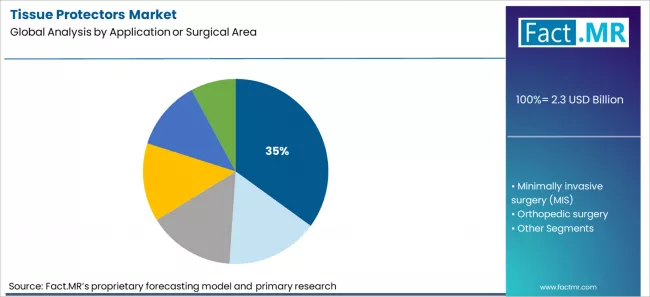
Application patterns in the tissue protectors market show abdominal and general surgery accounting for 35.00% of total demand. This specialty covers a wide mix of procedures that involve large fields, extended exposure time, and frequent instrument movement. Operating lists in these departments run at high volume across most hospitals, which creates steady consumption rather than episodic demand. Case protocols often specify multiple protection steps for incision edges and surrounding tissue. Supply carts and preference cards reflect this frequency through default inclusion of protection devices. Minimally invasive, orthopedic, cardiovascular, and obstetric procedures also rely on protective products. The breadth and cadence of general surgical work keep this area as the main driver of overall volume movement.
What are the Drivers, Restraints, and Key Trends of the Tissue Protectors Market?
- Drivers: Rising number of surgical procedures and the need to protect healthy tissue during operations are increasing use of tissue protectors in hospitals and ambulatory surgical centers to reduce collateral damage and improve surgical outcomes.
- Restraint: Budget constraints in healthcare facilities and competition from lower-cost alternatives limit purchasing of advanced tissue protector systems in some regions.
- Trend 1: Growth in development of single-use, sterile tissue protector systems designed to simplify setup and reduce infection risk.
- Trend 2: Increased adoption of anatomically contoured protectors that enhance fit and protection across diverse surgical applications.
Analysis of the Tissue Protectors Market by Key Country
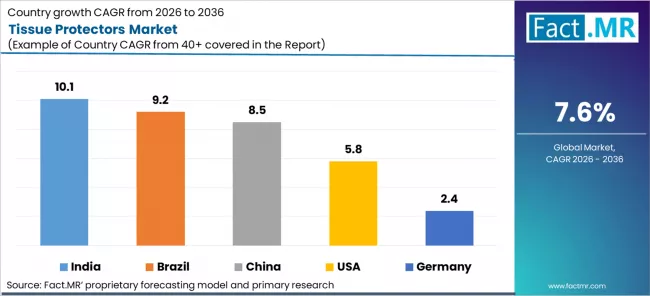
| Country | CAGR 2026 to 2036 |
|---|---|
| USA | 5.8% |
| Brazil | 9.2% |
| China | 8.5% |
| India | 10.1% |
| Germany | 2.4% |
The report covers an in-depth analysis of 40+ countries; top-performing countries are highlighted below.
How Are Surgical Standardization Protocols in USA Shaping Use of Tissue Protectors?
Growth in USA runs at about 5.8% per year through 2036. Usage follows procedure volumes across orthopedic, general surgery, and trauma cases rather than isolated product adoption programs. Product selection focuses on reliability, ease of placement, and compatibility with existing surgical kits. Central supply teams influence most sourcing decisions through framework contracts. Switching between suppliers happens slowly because protocols and staff training are already embedded. Volume increases track operating room throughput and case mix changes. Distribution remains centered on large medical distributors serving hospital networks. Contract renewals depend on service levels and delivery consistency. Demand patterns remain stable, with incremental growth linked to surgical volume expansion rather than to new product feature cycles.
What Is Driving Faster Expansion of Tissue Protectors in Brazil?
A pace near 9.2% per year through 2036 defines growth in Brazil. Demand rises from expansion of private hospital groups and higher surgical throughput. Many facilities continue upgrading basic surgical infrastructure, which increases baseline consumption of disposable protection products. Purchasing decisions balance price, availability, and distributor support. Stocking policies often include higher buffers due to supply variability. Volume growth follows operating room expansion and trauma caseloads. Distribution relies heavily on regional suppliers serving multi-site groups. Contract wins depend on delivery reliability and commercial terms. Market development remains tied to private sector hospital investment rather than to centralized public procurement reform.
What Is Supporting Wider Adoption of Tissue Protectors in China?
Expansion in China stays close to 8.5% per year through 2036. Hospital capacity growth and rising surgical volumes shape most demand patterns. Use concentrates in orthopedic, trauma, and general surgery departments. Procurement aligns with centralized hospital purchasing plans and annual budget cycles. Standardization programs influence product specifications and supplier shortlists. Rollouts often occur in phases tied to hospital expansion projects. Local manufacturing presence and service coverage affect supplier choice. Volume growth follows bed additions and procedure count increases rather than shifts in surgical technique. Market development remains linked to institutional capacity buildout rather than to premium product substitution.
How Are Multi Site Hospital Networks in India Changing Use of Tissue Protectors?
A growth rate near 10.1% per year through 2036 sets the pace in India. Expansion of private hospital chains and higher surgical throughput explain most new demand. Standard surgical kits increasingly include protection components, which raises baseline usage. Purchasing decisions emphasize unit cost, availability, and distributor reach. Inventory policies favor frequent replenishment because storage space remains limited. Volume growth tracks operating room utilization and bed occupancy rates. Distribution depends on regional suppliers servicing chain accounts. Contract awards follow network level negotiations. Market growth remains driven by capacity expansion rather than by changes in surgical practice or rapid technology shifts.
What Is Defining Demand Patterns for Tissue Protectors in Germany?
Germany maintains growth near 2.4% per year through 2036. Utilization remains stable due to mature hospital infrastructure and slow change in procedure volumes. Procurement follows strict tender processes and compliance requirements. Product specifications remain conservative and focused on reliability and material standards. Supplier changes occur infrequently because training and protocol updates carry administrative cost. Volume trends reflect demographic shifts and length of stay management rather than surgical capacity expansion. Distribution remains concentrated among established medical supply groups. Market development stays incremental and tied to efficiency programs rather than to overall growth in clinical activity.
What Determines Supplier Leverage in the Tissue Protectors Market?
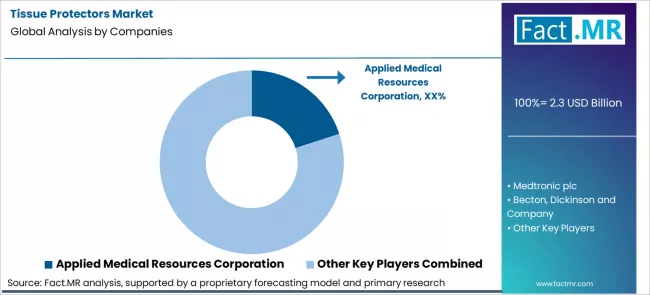
Operating room throughput planning often decides supplier access before contracting teams become involved. Hospitals map incision sizes, instrument flow, and draping sequences during procedure redesign, then align disposables to those pathways. Applied Medical, Medtronic, Becton, Dickinson, Cardinal Health, and Mölnlycke compete by fitting into these predefined workflows rather than by bidding on single items.
Product managers are evaluated on placement speed, barrier integrity, and consistency across surgical specialties. Logistics teams also weigh packaging formats and availability for case cart assembly. Once a protector is embedded into a standardized setup, volumes follow block scheduling and service line expansion. Supplier displacement usually appears after service reconfiguration, tray rationalization, or changes in surgical access techniques.
Key Players in Tissue Protectors Market
- Applied Medical Resources Corporation
- Medtronic plc
- Becton, Dickinson and Company
- Cardinal Health, Inc.
- Mölnlycke Health Care AB
Scope of the Report
| Items | Values |
|---|---|
| Quantitative Units (2026) | USD billion |
| Product Type | Wound edge protectors or retractors, organ or tissue protection pads and sheets, laparoscopic trocar site protectors, nerve and tendon protectors, barrier drapes and localized shields, other tissue protection accessories |
| Application or Surgical Area | Abdominal and general surgery, minimally invasive surgery (MIS), orthopedic surgery, cardiovascular and thoracic surgery, OB or GYN surgery, other surgical specialties |
| End User or Sales Channel | Hospitals, ASCs, specialty surgical centers, distributor channels, GPO or tender procurement |
| Regions Covered | Asia Pacific, Europe, North America, Latin America, Middle East & Africa |
| Countries Covered | United States, Canada, Mexico, Germany, United Kingdom, France, Italy, Spain, Nordics, BENELUX, China, Japan, South Korea, India, Australia & New Zealand, ASEAN, Brazil, Chile, Saudi Arabia, Turkey, South Africa, and other regional markets |
| Key Companies Profiled | Applied Medical Resources, Medtronic, Becton, Dickinson and Company, Cardinal Health, Mölnlycke Health Care |
| Additional Attributes | Dollar sales by product type, application, and end user; dimensional accuracy, material stability, and barrier performance; protocol standardization, case cart integration, and consumption linked to procedure volumes |
Tissue Protectors Market Segmentation
-
Product Type :
- Wound edge protectors or retractors
- Organ or tissue protection pads & sheets
- Laparoscopic trocar site protectors
- Nerve & tendon protectors
- Barrier drapes & localized shields
- Other tissue protection accessories
-
Application or Surgical Area :
- Abdominal & general surgery
- Minimally invasive surgery (MIS)
- Orthopedic surgery
- Cardiovascular & thoracic surgery
- OB or GYN surgery
- Other surgical specialties
-
End User or Sales Channel :
- Hospitals
- ASCs
- Specialty surgical centers
- Distributor channels
- GPO or tender procurement
-
Region :
- Asia Pacific
- China
- Japan
- South Korea
- India
- Australia & New Zealand
- ASEAN
- Rest of Asia Pacific
- Europe
- Germany
- United Kingdom
- France
- Italy
- Spain
- Nordic
- BENELUX
- Rest of Europe
- North America
- United States
- Canada
- Mexico
- Latin America
- Brazil
- Chile
- Rest of Latin America
- Middle East & Africa
- Kingdom of Saudi Arabia
- Other GCC Countries
- Turkey
- South Africa
- Other African Union
- Rest of Middle East & Africa
- Asia Pacific
References
- World Health Organization. (2023). WHO global report on infection prevention and control. World Health Organization.
- European Commission, Medical Device Coordination Group. (2023). Guidance on classification of medical devices under Regulation (EU) 2017/745 (MDR). European Commission.
- International Organization for Standardization. (2023). ISO 13485: Medical devices – Quality management systems – Requirements for regulatory purposes. ISO.
- International Organization for Standardization. (2023). ISO 11737-1: Sterilization of health care products – Microbiological methods – Part 1: Determination of a population of microorganisms on products. ISO.
- National Institute for Health and Care Excellence. (2023). Surgical site infections: Prevention and treatment. NICE.
link




More Stories
Voltage Regulators Market Analysis: End-Use Segments & Revenue Forecast
$9.71 Bn Electric Two Wheeler Market Analysis by Vehicle, Voltage Type, Motor Type, Battery, Motor Power, Technology, Vehicle Class, Usage, Region
Grain Alcohol Market Analysis: Segmentation, Major Trends,